This is a response to the report entitled “Seeing The U.S. Industrial Hemp Opportunity” (2023) by bioSolutions Initiatives, sponsored by IND Hemp of Montana.
On page 33 is:
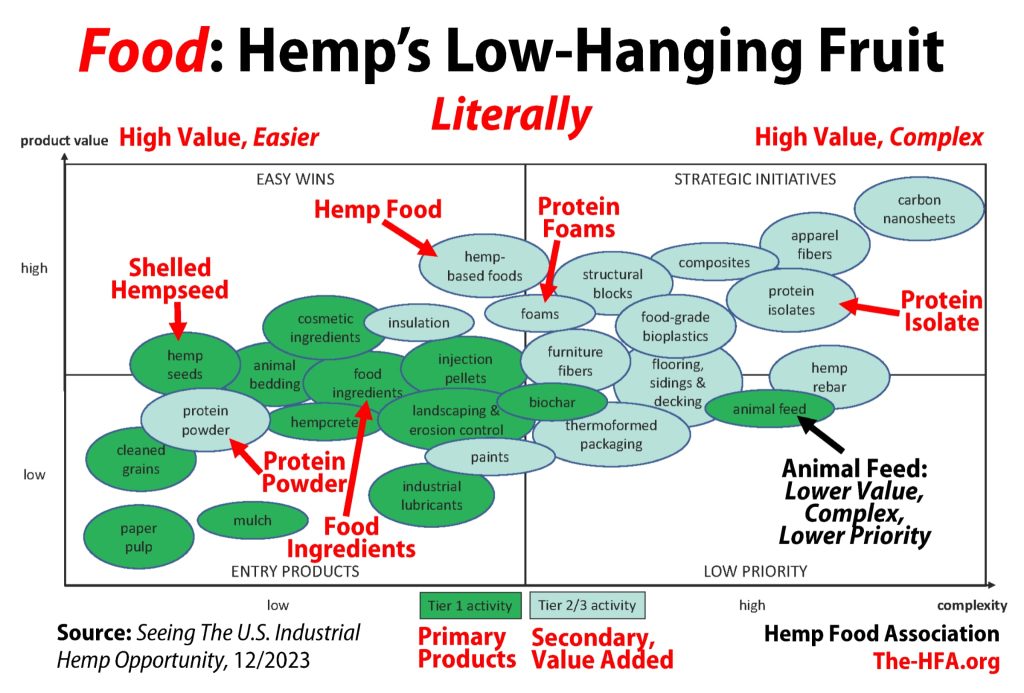
“8.1 Value-Complexity Matrix for Industrial Hemp Products
The matrix below categorizes some of the multiple applications of industrial hemp in order to prioritize market development. Obviously, this nascent industry should concentrate on the “entry products” and “easy wins” categories.
By “product value”, we understand here the monetary value to a processor, whether a Tier 1 [primary products], Tier 2 [secondary processed products], or Tier 3 [products further processed]. One dimension not included here are geographical specificities: one region or state might be better at producing fibers for textiles than another, given their climate, soil, or even the industrial know-how around them.
The “complexity” measure encompasses capital expenditures, technology maturity, technical expertise, and regulations. It is important to remember that no research on industrial hemp had been done in the U.S. for 80 years. As the industry restarts, everything needs to be learned, invented, or approved.
Several questions come to mind when considering the matrix:
- Since the current U.S. production capacity is small, what are the markets that should be given priority?
- Should a diversified production model be pursued to spread risk, or should a limited number of large markets be targeted?
- When will the supply chain be stable and consistent?
Answering these questions will require a concerted effort by the pioneers of the industry, leveraging the learnings from other countries and industries. One core objective of the Sustainability Alliance is to facilitate those discussions and advance optimal methodologies to develop the industry.”
As a pioneer since 1994 of what became hemp’s first billion-dollar segment, keeping her alive during the dark ages by pivoting from using tons of soybeans to hempseed for my commercial foods, I’ll answer their questions:
“Since the current U.S. production capacity is small, what are the markets that should be given priority?”
Your chart tells the story: food made from hemp grain. Period.
The food industry is massive and diverse, and very easy to enter. CPG packaged branded foods, foams from the protein, technical food ingredients, protein isolates and concentrates, hemp protein powder, etc. are all on your chart.
Shelled hempseed is already on every grocery store shelf on the continent including Walmart and Costco, almost all supplied by foreign farms. So are foods made from it like cereal.
With millions of consumers, thousands of retailers, and fat margins, 100% legal hemp foods already drive acres in Canada, China, and elsewhere.
Hemp foods can even be sold when one has no farm, factory, or finances by using contract manufacturers to make them for you. Learn more from Seedy! by Richard Rose (2024).
Having done it before since 1980 with vegan foods then hempseed foods, smokable hemp via Nobacco, and CBD via the Medicinal Hemp Association, I know what’s involved now to make it a success, and this is an idea that just takes vision and courage. If I can do it, believe me anyone can with a little guidance.
Note that the chart shows animal food is more complex due to regulations and returns a lower value. However, it’s still a critical component of the human food segment as they need a market to unload inferior seed.
“Should a diversified production model be pursued to spread risk, or should a limited number of large markets be targeted?”
The hyperbolic motto “25,000 products from hemp” implies a diversified path, but looking at where the easy wins lie it’s clear that the low-hanging fruit is food. Literally (hempseed is botanically a fruit).
Food is an extremely wide and diverse national market, from raw shelled seed to sophisticated technical ingredients to branded foods and foodservice containing 5-10% hempseed.
From the smallest chocolate shop to the largest multinational conglomerate, all can make and sell foods containing delicious and nutritious hempseed.
Heck, 25,000 food products are possible just within hemp! Virtually any product can contain the protein- and omega-3-rich seed.
“When will the supply chain be stable and consistent?”

When the U.S. hemp industry quits beating around the bush and finally starts doing the Right Thing, uniting behind hemp foods as the tip of the hemp normalization spear.
Organize a co-op, grow for grain, make foods under the co-op’s brand, sell it. Many thousands of acres within an hour of the processing plant, likely in the northern latitudes.
Some smart Governor will choose to be the “hemp grain state,” concentrating production and processing there. Then in good times or bad people will need to eat, sometimes even thrice a day.
And that would be the rare hemp industry Win-Win: growing for grain yields at least 4-times more in fibrous stalks thereby providing a second income source for the farmer and a bunch of hurd for hempcrete, etc. If you want more hemp fiber, then push for more hemp grain.
If you want to see hemp progress in America, support hemp foods with your voice and dollars. Give them a reason to make it so.
Click here to download the free report “Seeing The U.S. Industrial Hemp Opportunity” (2023) by bioSolutions Initiatives, sponsored by IND Hemp of Montana. [PDF].