Hemp Used to Mean Fiber and Grain
For years, “Hemp” meant fiber and grain and “Marijuana” meant THC.
Until now.
The era of “hemp is hope, hemp is rope, but hemp is not dope” is over.
While “you can smoke a ton of hemp and not get high” is still true, “you can’t get high on hemp” is not. Neither is “CBD can’t get you high.”
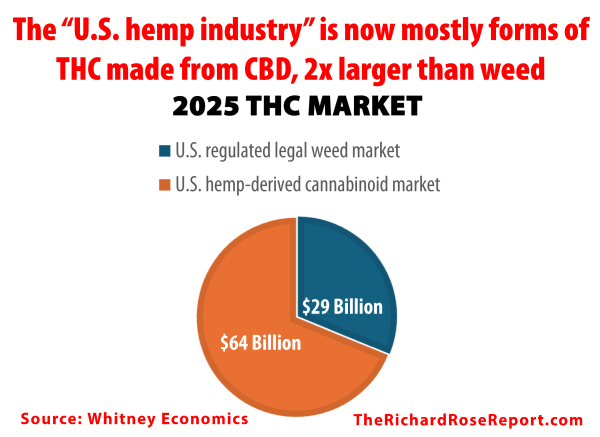
Even in the darkest days of Prohibition under “Just Say No” Reagan, no one wanted THC isomerized from hemp… yet today it is a $64 billion business all on 2/3 fewer acres than are planted to sesame seed.
As fast as domestic hemp acres fell, 95% in five years, “Hempnoid” (delta-8 THC, delta-9 THC, delta-10 THC, HHC, THC-P, THC-O, etc., but not THCa which is just marijuana anyway) sales grew in vape pens, gummies, and drinks for sale in gas stations to teens mostly in red states.
The Goodness of Hemp proposal provides “back-door” regulatory approval for animal feed and THC beverages while doing little for hemp’s largest legal market, grain.
It bans topicals, tinctures, capsules, suppositories, smokable, and vapes.
The proposal drags hemp into an unfamiliar realm, one that didn’t exist even seven years ago: as a raw material to synthesize THC.
Non-existent for 99.9% of hemp history, yet here we are using “the goodness of hemp” grain and fiber to legalize and normalize canned beverages containing the dirtiest forms of man-made THC, to be sold in the mass market.
Proposing a radical and fundamental 180° change in the definition of hemp and thus the “hemp industry,” it appears to be little more than a special-interest legislative wish list by a few companies in two very narrow segments willing to throw money at it: animal feed and THC drinks ostensibly synthesized from hemp.
And it is going to fundamentally redefine and hobble industrial hemp in America for generations, which just might be the point.
The Proposal and Why It Is Happening Now
The Goodness of Hemp is a regulatory framework proposed by the National Hemp Association to address impending federal restrictions that reclassify “hemp THC” products as Schedule 1 controlled substances in December.
The proposal outlines a three-tiered oversight model for THC drinks involving the USDA, FDA, and TTB to separate non-intoxicating industrial hemp from intoxicating cannabinoid products. “Goodness of Hemp” is a registered trademark and brand of the National Hemp Association.

Why is this happening now? The largest Cannabis companies and beer distributors in North America want in on THC beverages in U.S. mass markets. There is big money behind it to get so many fiber/grain hempsters to finally support hemp foods despite those “foods” only being stony THC drinks and not protein and omega-3 sources. For instance, none are members of the Hemp Food Association, since 1998 dedicated to that industry, hemp’s largest and most profitable segment.

The alcohol company that makes Sam Adams beer and Twisted Tea hard iced tea also makes the number one cannabis (THC) iced tea in Canada; that a booze giant participating directly in a regulated cannabis market is proof of where this is all heading.
Why not use trichomes from real, actual living phytocannabinoids from realcannabis plants? Because importing foreign CBD isolate and converting it to THC is a fraction of the cost of growing it, but that’s only because marijuana is strictly regulated but hemp is not. Same effect, same drug, same molecule, but one is grown by God and the other is manufactured by man and contaminated af.
The THCa Loophole
While some point to the alleged loophole, for products relying on THCa for compliance, that only works if you ignore the decarboxylation requirement in the Farm Bill. Under Section 297B of the Agricultural Marketing Act of 1946 (added by Section 10113 of Public Law 115-334), the text regarding testing reads: “(2) CONTENTS.—A State or Tribal plan referred to in paragraph (1)—(A) shall only be required to include— […] (ii) a procedure for testing, using post-decarboxylation or other similarly reliable methods, delta–9 tetrahydrocannabinol concentration levels of hemp produced in the State or territory of the Indian tribe; […]”
“THCa Hemp,” on the other hand, is another regulatory anomaly enabled by a state’s interpretation of the definition of hemp: 0.3% delta-9 THC. With the latter, even 30% THCa Kush is legally “Hemp.” It’s one way growers of Type 1 in CA and OR can dig out of the financial hole the state threw them into. (THCa is only converted to delta-9 THC upon heating).
Call it Schrödinger’s hemp: harvested hemp that has not yet been harvested. The federal definition indirectly requires a post-decarboxylation testing method, which converts the acid form THCa into THC. So THCa material, when tested pursuant to federal law, will always read as THC. The entire THCa industry is predicated on ignorance of that simple fact. Luckily, no one is in jail over it. Yet.
Hemp THC disintermediates domestic farmers and extractors in favor of labs and stainless steel tanks using foreign hemp, just to save money for a few at the top. At least 40 states have already restricted Hempnoid sales.
Like the THCa segment, this one appears to know that it was just an opportunistic play, all along. That’s the only thing that explains taking no steps to ensure long-term sustainability, whether legal, lobbying, PR, or marketing. When your lawyer has to be your PR agent selling a profoundly dubious story at a hemp expo, you’re in trouble.
And now the federally illegal, state-legal Cannabis dealers are complaining about unfair competition from federally legal, state-illegal Cannabis dealers’ hemp THC.
Opposition, Competing Bills and the Deadline
The large and well-financed state-regulated marijuana industry will fight hemp THC tooth and nail, as will states that stand to lose tax revenues from it. The U.S. Cannabis Roundtable, whose CEO Saphira Galoob took the message to Capitol Hill, urged Congress to keep the Farm Bill loophole closed, warning that it has fueled unregulated and synthetic drugs, often for sale to children, and that Congress is ready to shut the door on “gas station weed.”
While some view The Goodness of Hemp Act as a balanced compromise to save the industry from an impending total ban, it faces significant hurdles. Although it has circulated among some policymakers and stakeholders in their circle, the draft remains only an industry proposal. As of August 2026, they are still actively searching for a member of Congress to formally introduce it.
One would think that if the goal were the best possible document with the widest possible support, it would be shared with those of us who have worked on hemp policy since the last century. It was not; I had to ask for it.
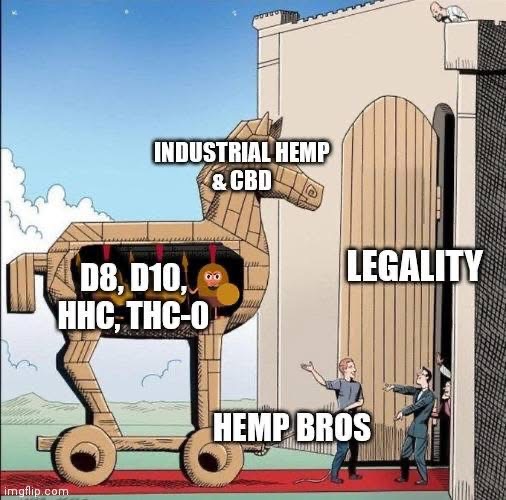
Under those circumstances, it looks less like a consensus document and more like a sly piece of regulatory capture: a Trojan Horse for back-door approval of THC beverages and of hemp grain for animal feed, bypassing FDA protocols.
It’s a THC legalization bill but without the marijuana.
They’ll say the industry is united behind it. It is not, not by a long shot. “If everyone is thinking alike, then someone is not thinking.” —Patton
The proposal faces competition from bills already introduced. For instance, the Lawful Hemp Protection Act (H.R. 9830) was formally introduced in July 2026. Because H.R. 9830 is already moving through House committees, it currently holds more legislative momentum. It criminalizes consumers and patients for possessing hemp THC products.
Other hemp bills: S. 2112: HEMP Act of 2025; S. 4315: Hemp Safety Enforcement Act; S. 3686: Hemp Planting Predictability Act; H.R. 7212: Hemp Enforcement, Modernization, and Protection Act; H.R. 7024: Hemp Planting Predictability Act; H.R. 6209: American Hemp Protection Act of 2025; H.R. 7010: To amend the Agriculture, Rural Development, Food and Drug Administration, and Related Agency Appropriations Act, 2026, to delay the implementation of amendments made by such Act to the hemp production provisions of the Agricultural Marketing; and H.R. 10079: Beverage Regulatory Parity Act. H.R. 7024 has by far the most momentum of the hemp bills, with 41 House members cosponsoring (up from 17 in January), reflecting broad industry support for simply buying more time rather than picking a permanent policy fight. Many of the lawmakers supporting the Hempnoid ban won re-election this November.
Complicating the effort, Democrats gained seats in Congress and across the nation, thus opening the door to legalization in more states such as Pennsylvania and Texas, and a senior Trump adviser said the President would sign a “clean” marijuana descheduling bill passed by Democrats such as the MORE Act, meaning lacking social equity provisions. Further complicating it for Hempnoid producers, their ace-in-the-hole for protection, the mother-in-law of the owner of one of the largest companies was Trump’s Chief of Staff, sacked three days after the November drubbing.
The delay approach (via H.R. 7024 or the CR) has the most real momentum; the regulatory-framework bills (H.R. 9830, H.R. 7212, H.R. 10079) are earlier-stage and more likely to be the basis of eventual negotiations than to pass as written.
But the best one so far is the Protecting American Hemp Farmers Act (H.R. 10929), which might actually drive production back onshore. New duty of 50% only on cannabinoid products imported from China under the True hemp (Cannabis sativa L.), raw or retted fiber or stalks, Hemp seed, or Hemp oil tariff codes. Requires new import tariff categories for each cannabinoid product: isolates, distillates, naturally derived, synthetic, and chemically altered cannabinoids. Testing for cannabinoid imports: heavy metal content, molds, and mycotoxins, pesticide residues, microbial contamination, residual solvents, and synthetic byproducts and unknown compounds. Prohibits transshipment to evade the tariff. Mandates reporting.
The underlying deadline driving all of this is Public Law 119-37 (the FY2026 agriculture funding law), which redefined hemp and is set to reimpose stricter federal rules on November 12, 2026 unless Congress acts.
The biggest challenge is time. A federal “total THC” restriction is set to take effect soon. Passing an intricate, entirely new multi-agency regulatory structure through a Congress frequently on recess before the deadline is a massive uphill battle.
On August 8, 2026, the Senate passed a stopgap funding bill (H.R. 6500) 90-6 that would push most of the November 12 deadline to December 11, 2026, separately from all the hemp bills. The House passed it on September 1, 2026.
This delay wouldn’t stop the synthetic cannabinoid ban from taking effect November 12 as scheduled. The new federal rule rewrites the definition of hemp to use a “Total THC” standard and places a strict 0.4 milligram per-container cap on products. This change will effectively eliminate the federal hemp loophole nationwide, forcing all intoxicating cannabinoids into state-regulated cannabis systems, as well as most CBD products.
All seed that produces Cannabis plants with greater than 0.3% THC is also banned as a side effect of the fight, returning to the same status as before the 2018 Farm Bill.
The delay pushed the ban until after the November 3 election, and now it might just fall right off the agenda after what was a stunning election. The marijuana decriminalization bill (MORE Act), which passed the House twice in recent years, was sponsored by that party, which also saw an influx of new and younger blood in the election. Republicans want to see it monopolized by Big Pharma via rescheduling to Schedule 3, keeping it illegal for you and me without a ‘script.
While The Goodness of Hemp proposal attempts to please everyone, different factions of the multi-billion-dollar hemp economy have competing interests. Industry leaders have noted that the bill still needs “targeted refinements” to perfectly balance the needs of industrial grain and fiber farmers, low-dose beverage brands, and cannabinoid processors.
Indeed, at the end of this article, I outline what the hemp food and grain industry, hemp’s largest segment with products on the shelves in supermarkets in North America and Europe, needs for continued success.
Hempnoid Safety: What the Record Shows
In 2019, the Centers for Disease Control and Prevention blamed vaping for a series of lung injuries that hospitalized more than 2,500 people and killed 68. Those injuries were linked to mostly black-market vape cartridges containing the chemical vitamin E acetate.
Since then, the connection between vitamin E acetate and that public health outbreak has been widely publicized. Yet a scientist whose company in Massachusetts has tested about 5,000 delta-8 products says many still test positive for vitamin E acetate. Although delta-8 vape pens are a chemical soup, only some of which is D8, in the past two years, there have been only 104 hospitalizations directly linked to delta-8; more than half involved edibles.
But these Hempnoids do prove the 89-year lie that is marijuana prohibition: dirty forms of synthetic THC in vape pens, drinks, and gummies, often sold to teens from gas stations in red states, yet all with remarkably few problems.
Sure, the material is contaminated and possibly toxic and uncontrolled and unregulated, but that proves my point: nevertheless, no one died.
It showed us that THC is so safe that even manufacturing the dirtiest forms of it that neither the body nor the plant has ever seen before for teens to vape with vitamin E didn’t require the enormous set of rules that the regulated marijuana industry labors under.
Regulated marijuana is way safer and cleaner than manufactured synthetic THC, and short of infection, always will be. But all those regulations also push up the cost of production, likely the original point of them, thus making the unregulated conversion of CBD to THC cheaper until the regs catch up.
Reclaiming the Meaning of Hemp
THC (marijuana) laws and stigma have long been hemp’s biggest obstacles. If THC from hemp is normalized, then grain and fiber will be saddled again with the same stigma we thought we escaped in 2018 with the Farm Bill.
“Hemp” has to reclaim the meaning it has had for 12,000 years until 2020 when desperate processors sitting on too much CBD turned it into THC. Hemp has long been a annual bast fiber plant producing proteinaceous seeds, not a source of THC; in fact it has long been defined by its lack.
And “hemp” is a legal fiction anyway: for millennia the definition was by end-use, fiber (northern latitudes) or drug (southern). Even some non-Cannabis plants have been called “hemp” in the past as well as today, Sunn Hemp is but one.
And not all nations agree on the definition, as it varies from 0.2% to 1% Total THC. The U.N. even has a definition of hemp as “CBD:THC ratio >1,” and Switzerland once did it by end-use. Legacy Hemp of Wisconsin has proposed regulating by end use in the U.S., as well. Ultimately, it might be the only practical method.
But changing the hemp narrative from grain and fiber to THC is a monumental error in marketing of what was this thing we called “hemp” forever. This is such a critical issue for hemp foods that for years I even put a slashed THC symbol on my food packages so as to answer everyone’s first question and move on to the product’s benefits instead of their fear.
Compromising hemp’s largest and most profitable market (seed for food) for THC drinks is a profoundly short-sighted mistake and will haunt hemp grain and fiber companies for decades to come, while poisoning THC consumers.
Two Industries and the Green Rush
The “hemp industry” is really two: primary production and processing-on. The big money is in the processing, but without production nothing gets done. So then the question becomes one of cost vs. hassle.
In today’s globalized economy, companies in high-cost nations need to create a new supply/distribution chain model which leverages exclusive assets such as brands, reputation, or even location. Literally a temperate-latitude weed, hemp can be grown naturally almost anywhere in the world except the tropics, and even then, if you have lights you can grow it for seed.
But today in hemp, branding is an afterthought if any is given at all.
In 2018, the assumption of continued natural success in the U.S. hemp industry meant there was no imperative to do it right, as if everyone knew the same as everyone else and no true experts were available to consult or strategize with since success was divinely assured.
They didn’t look 3 or 5 steps down the road, but right in front of them: “Let’s harvest this crop, then figure out whom to sell it to.” At the expo, they were led to believe they could make millions on their CBD crop; none did.
After hemp was legalized federally in 2018 via the Farm Bill by removing it from the Controlled Substances Act, the U.S. hemp industry was flooded almost overnight with green-rush grifters, gold-seekers, and Republicans. It followed the national political scene, celebrating hustlers and mocking expertise.
At the expo, instead of hearing about grain success stories and fiber farming, they learned about THC and acid catalyzation of CBD. The CBD processors pivoted to converting it to THC, even in Colorado, where sales were illegal but not production. No bizarre compound was off-limits, no matter how toxic the byproducts of manufacture: delta-8 THC, delta-9 THC, delta-10 THC, HHC, THC-P, THC-O, plus their production artifacts, put into vape pens and gummies for sale to teens from gas stations in red states.
How U.S. Hemp Crashed: As Went the Nation, So Went Hemp
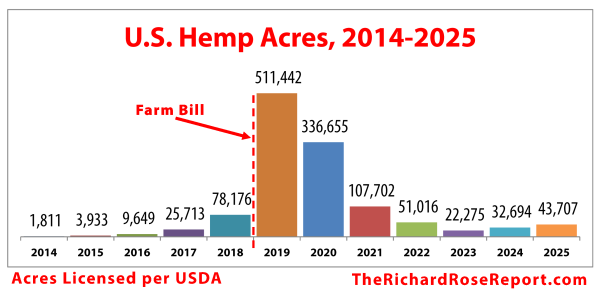
With such bright horizons and hope for the future after legalization, acres exploded to six times their 2018 level in 2019. Then the industry did an epic face-plant, losing 95% of acres in the next five years. How? U.S. hemp suffered from many of the same social and political flaws as the nation did: party over country, with loyalty rather than expertise or accomplishment determining speaking slots and awards. The industry got off on the wrong foot, the very wrong foot.
Like with Trumpism, “Hempism” in America demanded total loyalty to the “party,” which was essentially the people who attended the hemp expos together. Critical information was hoarded and shared with the special few, and that party wanted biomass, lots and lots of biomass. It ignored the people who actually created a U.S. hemp industry worth legalizing, preferring the loudest and bullshitiest. Much like Republicans in power drove the nation off a cliff, so too did they in hemp, and for much the same reasons: in both cases creating a kakistocracy, rule by the worst.
Incompetence was now a virtue, experience laughable. Fact-based professions became the enemy; every wild theory was embraced. The most viral story was a hemp plane that was a fraud from the start by a serial scammer.
Like the zeitgeist of the day, spectacle superseded truth, puff over substance, more show than go, fake it ‘til you make it; lies and gaslighting were the new marketing tools. No grift was too big to fail, and bankruptcy was just one click away. They had no idea how anything worked, the blind leading the blond. Profit was God, or at least one of Them. Loyalty to bad people doing bad things was more important than ethical experts who actually did it before.
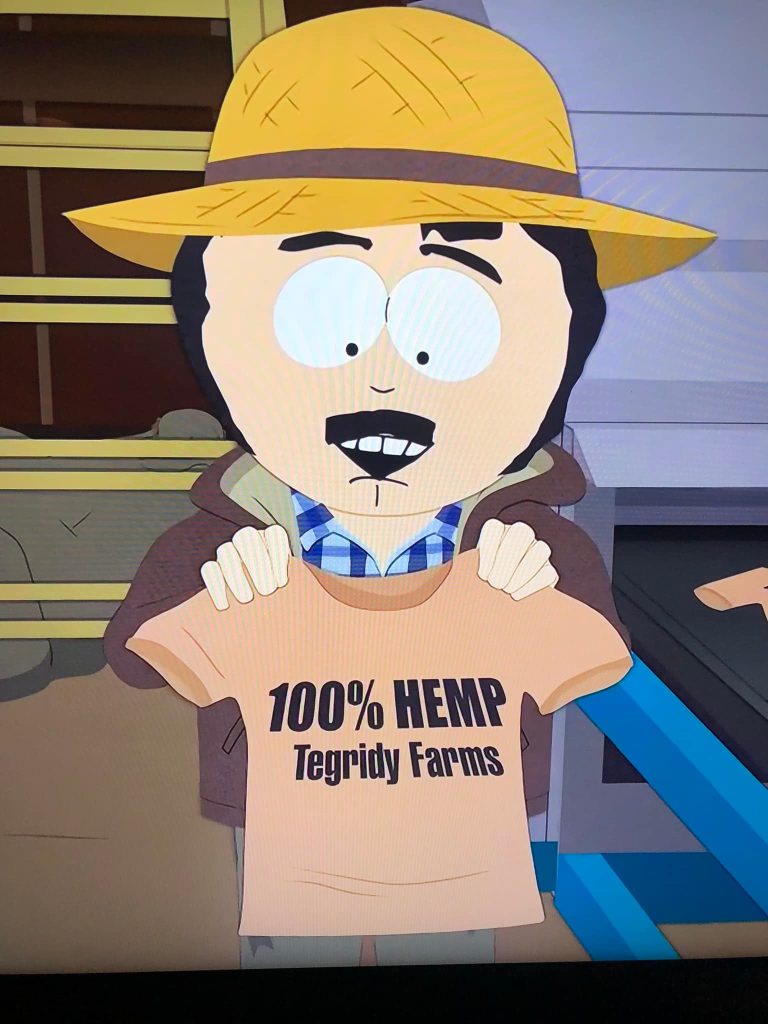
They gave us keynote speeches by a pot lawyer secretly in competition and a goat-herder; at least one human trafficker and another who was hiding a fugitive rapist were feted. One keynote speaker was instead detained in Saipan on money-laundering charges. The lack of integrity in hemp was even parodied by South Park, with its Tegridy Farms episodes.
Controlling information was critical to their success and ultimately hemp’s failure:
“What was upsetting was that when I spoke to the groups in the ESG breakout session, they were told to focus on cannabinoids and not food, feed or fiber because the farmers aren’t ‘ready’ to face those challenges – that was straight from the head of NOCO.”
Much like that orange business icon who used the bankruptcy courts to get rich six times, including two casinos, it was just considered smart and clever to screw small businesses, not a moral failing. So they did, one after another. The main 2019 NoCo sponsor GenCanna was bankrupt a year later, owing over $100 million.
Seed companies hoarded billions and billions of beans without paying farmers, much like those billionaire real estate developers who stiff small contractors as a routine business practice.
Instead of letting grain go stale waiting for animal feed approval from FDA’s CVM, those seed companies could have jump-started a new domestic hemp food industry. That would have generated cash to pay the farmers, replenished stocks, and encouraged them to grow more while also building domestic supply for hemp’s largest market. Instead, years later, they have litigation.
Today, “hemp” has become but a platform for performative content generation and not much else, a hole in the ground the farmer pours money into. U.S. hemp saw rapid expansion, oversupply, and collapsing prices, with small farmers left holding the bag for it all. The resulting glut of CBD precipitated the crisis; processors were desperate to move it, so they made THC.
Most U.S. states have moved to ban or severely restrict intoxicating hemp-derived cannabinoids. States have taken this action because one view is that the 2018 Farm Bill only restricted delta-9 THC to 0.3%, creating a massive legal loophole by ignoring the later decarboxylation provision. Manufacturers leveraged this gap to chemically synthesize alternative intoxicating THC compounds from legal hemp, completely bypassing state marijuana laws.
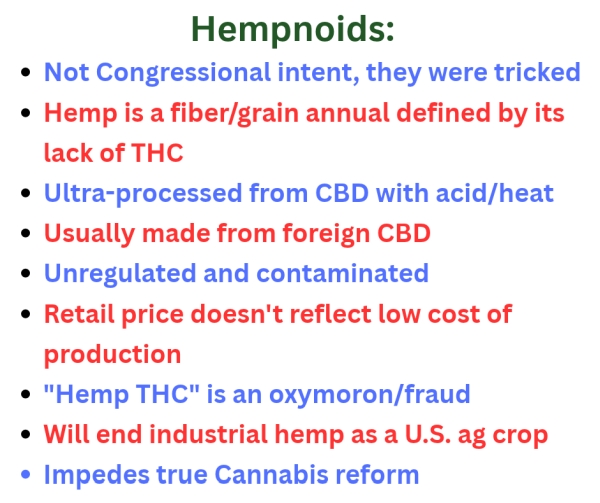
The risk of these Hempnoids is not as much in the target THC molecule itself, whether delta-8, -9, -10, etc. Those are known and studied molecules with benefits. Rather, the risk is in the residual solvents and other byproducts of that chemical process such as cannabinodiol, cannabinol-O-acetate, cyclohexyl-cannabidiol, d7-tetrahydrocannabinol, d8-iso-tetrahydrocannabinol, d10-tetrahydrocannabinol, d11-tetrahydrocannabinol, d3-tetrahydrocannabinol, d4(8)-iso-tetrahydrocannabinol, d6a10a-tetrahydrocannabinol, exohydrocannabinol, hexahydrocannabinol acetate, hexahydrocannabinol, hexahydrocannabiphorol, hydrated cannabidiol, pentahydrocannabinol, tetrahydrocannabidiol, tetrahydrocannabiphorol, tetrahydrocannabinol-O-acetate, and trans-d8-iso-tetrahydrocannabinol not found in the plant, and not studied in animals or humans. Also, contaminants coelute (hide) behind delta-8 when testing purity, overstating it. And when acetylating THC-O, contaminants also get acetylated.
Warren Buffett, the legendary investor, says that integrity is the prime attribute he hires for in an executive. A healthy young industry ecosystem would not create in-groups that exclude those whose successes are the foundation they are building on. It’s as though the industry has a pathological need to ignore the only proven and validated way forward for hemp.
Meanwhile, one well-known grifter who took down a hemp association for the benefit of another newer one received a Lifetime Achievement award. We get more of what we reward. An industry with a lack of integrity, well, it crashes 95% once legalized and pivots from true hemp to THC without blinking an eye.
The GenCanna and Atalo bankruptcies from 2020 are still unraveling six years later as the court forced farmers to pay back the previously paid invoices to the bankrupt customer, over $9 million, all of which went to the bank and investors while another insider picked up what was left. These companies were industry leaders in Kentucky that were held up as the pinnacles of hemp success back in the day when Sen. McConnell was still on their side.
While the money is in getting people high with hemp, the integrity isn’t. Ethics matter, and the general lack thereof was the main reason acres in the U.S. crashed so hard, so fast in just five years.
The original vision of American hempsters since Jack Frazier and Jake Graves was thousands of broad acres of green hemp growing grain and fiber, and it was NHA’s original vision as well as mine since 1994. But over the years that vision got hijacked for fun and profit, but mostly profit.
NHA has flip-flopped on cannabinoids, riding the CBD wave before eschewing all cannabinoids last year, only to resurrect its interest as monied drink producers jumped into a lobbying battle early this year.
Maintaining the integrity of one’s Vision is critical for success; karma doesn’t like wafflers and opportunists.
THC Beverages: Money, Markets and Risk
Apparently “hemp” is now all about those 10-100 mg THC canned beverages: that’s the big play and what The Goodness of Hemp is keen to legalize.
THC drinks have way more potential for them than non-alcoholic beverages ever did. Douglas Watters, founder of Dry Atlas – Alcohol Alternatives Media, says “THC beverages might be a bigger threat to alcohol than non-alc is. The story for non-alc options is largely additive. The stat everyone reaches for is NielsenIQ’s: 94% of non-alc buyers still buy alcohol. Non-alc sits next to booze. The THC numbers point somewhere else. MoreBetter tracked 4,516 people across 36 cannabis-infused beverages, with daily check-ins for three weeks: 65% drank less alcohol while using the products. About 50 days after the study ended, they went back and asked again, 63% were still drinking less. Only 2.4% were drinking more alcohol.” Most surprising was that 25.4% of post-study survey respondents (1,423) stopped drinking alcohol completely.
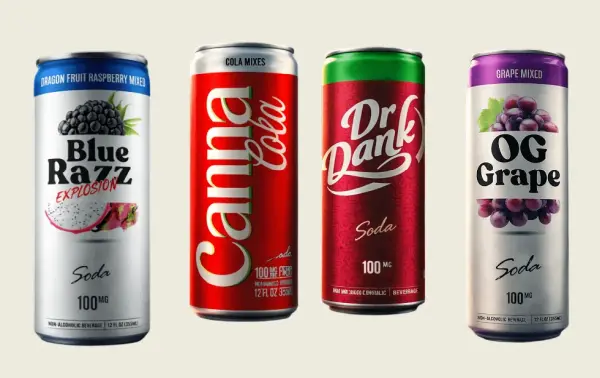
The potential public health improvement from THC drinks is massive, but let’s not swap one poison for another one; clean THC matters.
As their sales drop, beer distributors now want to own the THC beverage category channel, and on paper it makes sense for them: age-gated consumers, Dram shop law protection, similar difficult format (heavy cans of liquid), and it gets THC’s foot in the door with TTB… but what will each state’s alcohol beverage control boards think of it? They often have the mission of “protecting the public morals” or some such charge, THC has been demonized for so long that it might be a heavy lift for them.
Large marijuana multi-state operators (MSOs) want in on the action, too. Trulieve Cannabis Corp. was the third large U.S. cannabis company to launch a line of beverages containing THC. Curaleaf Holdings Inc., meanwhile, is selling its Select THC line of beverages, while Green Thumb Industries Inc. has invested in Agrify Corp., which bought the Señorita brand of hemp-derived THC beverages. Canada’s Tilray Brands Inc. launched Tilray Alternative Beverages late last year to sell hemp-derived THC beverages in U.S. markets. And Stiiizy, which is privately held, said it also plans to move into the hemp-derived THC category. For the cannabis companies, hemp-derived THC provides another revenue stream as fewer states move toward launching adult-use or medical cannabis programs.
There’s a long road ahead: no one knows what dose-risk is the right one and for which environments and consumers, how to communicate dosages to noob consumers, how alcohol co-consumption or high doses of THC affect them, how to underwrite insurance, or what blood THC/metabolite level indicates impairment and how to measure it.
The Alcohol and Tobacco Tax and Trade Bureau (TTB) is the federal “sin tax agency”… are we willing to concede THC is a danger, a health hazard akin to tobacco and alcohol?
In 1988, a DEA Chief Administrative Law Judge ruled that “Marijuana, in its natural form, is one of the safest therapeutically active substances known. The evidence in this record clearly shows that marijuana has been accepted as capable of relieving the distress of great numbers of very ill people, and doing so with safety under medical supervision.”
Yet here in The Goodness of Hemp it is being regulated not like a safe and healing medicine but like alcohol and tobacco, two of the most destructive substances known to man.
Are we willing to concede this point: that THC is as dangerous as alcohol and tobacco?
Perhaps when the THC is man-made, that argument could hold water as we don’t yet know what’s actually in those products, nor do we know what those compounds do to the body. But phyto, grown by God, is not that, not any of that; 12,000 years of human Cannabis use prove that.
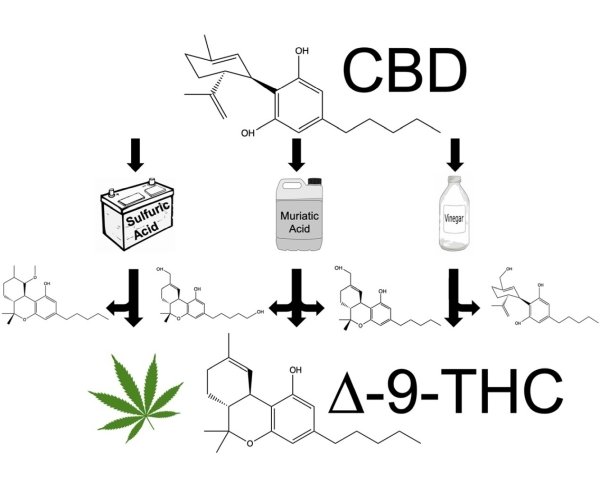
But there is a problem nobody puts on the label. The delta-9 THC in many of those cans did not come from a plant; it came from CBD isolate converted with acid and heat. Hemp does not produce enough THC by extraction, and founders in the category have said so publicly.
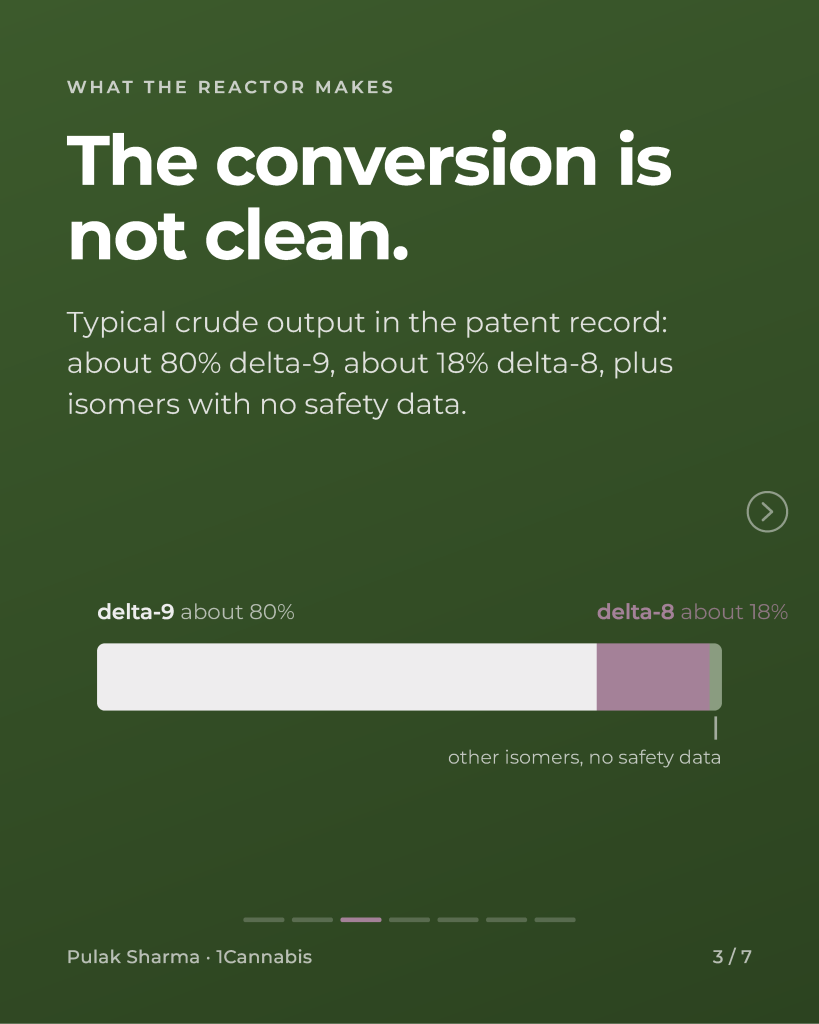
Nor is the conversion ever clean: published patent examples show crude outputs of around 80% delta-9 with 18% delta-8 and a tail of isomers the chemists themselves cannot fully name. The mix ships and is reported as “delta-9.” That is not a labeling nuance; it is consumer fraud.
THC drinks in Texas are $0.57 per mg of THC retail, although the raw D9 THC material is only 1 cent per mg, providing a 98.25% gross profit margin before COGS and channel profits.
With margins like that, you can see now why there is a big push to get this done, by hook or by crook, and leveraging the actual goodness of hemp fiber and grain and slipping in the back door is their easiest path right now.
But once hemp THC production is regulated like marijuana is, that price advantage will disappear. Or conversely, once marijuana is barely regulated like hemp THC is today, that price advantage is gone.
Especially after tort lawyers get wind of the dirty process in the FDA-regulated beverage. Each state still has THC in their Controlled Substances Acts as Schedule 1, triggering RICO. The bizarre compounds could be considered illegal analog controlled substances or unapproved new drug ingredients.
And what of the risk of drug tests for parents, police, truckers, pilots, etc? Noobs will be drinking sweet cans of THC, too many too fast, and they will all blame “hemp.” This will be an even bigger PR disaster than we have today. And in every newscast, “hemp” will be breathlessly mentioned a half-dozen times, as if it had anything to do with an actual plant.
Dram shop laws will be hard to apply if it takes 20-50 minutes to observe intoxication; thus, new ones will be needed. And while CBD or Citicoline can be used to manage intoxication, few will appreciate that expense.
FDA and DEA: Why This Is Still Illegal

The 2018 Farm Bill also made clear that nothing in it would affect or modify the FDA’s authority under the Federal Food Drug and Cosmetic Act (“FDCA”). After the 2018 Farm Bill’s passage, the FDA Commissioner publicly stated that “it’s unlawful under the FDCA to introduce food containing added CBD or THC into interstate commerce, or to market CBD or THC products as, or in, dietary supplements, regardless of whether the substances are hemp-derived,” such as THC drinks and gummies.
While the FDA has not issued a statement specific to delta-8 other than a warning, any substance intentionally added to food is a food additive, and therefore subject to pre-market review and approval by the FDA unless the substance is generally recognized as safe (GRAS). Other than hempseed products, no cannabis-derived ingredients have been the subject of a food additive petition, an evaluated GRAS notification, or have been approved for use in food by the FDA.
Therefore, sales of THC drinks and gummies remain prohibited by the FDA as a food or dietary supplement. As for delta-8 vapes, they may not be sold without FDA pre-market authorization. If sold as a drug, then vaping products cannot be marketed without an FDA-approved drug application.
And even if hemp-derived delta-8 is not viewed as “synthetically derived,” it would likely still be treated as a “controlled substance analogue” by the DEA. The Federal Analogue Act, 21 U.S.C. §813, treats a controlled substance analogue, if intended for human consumption, to be treated for the purposes of federal law as a controlled substance in Schedule I of the Controlled Substances Act.
A “controlled substance analogue” is any substance that has: (1) a substantially similar chemical structure to a schedule I or II controlled substance; and (2) a substantially similar stimulant, depressant, or hallucinogenic effect on the central nervous system. As to the first prong, the chemical structure of delta-8 and delta-9 are virtually identical.
With regard to the second requirement, experts estimate the effect of delta-8 to be approximately 75% of the potency of delta-9, which may easily meet the second requirement that the analogue have a “substantially similar” effect on the central nervous system. Given the near-universal agreement that the 2018 Farm Bill was not meant to legalize intoxicant products, DEA could view enforcement under the Federal Analogue Statute as consistent with the intent of Congress and the Farm Bill.
And the Loper Bright decision means Congress must get the law perfect the first time or risk getting tricked into creating yet another hemp loophole, but after getting burned the last time they did us a solid they might be thinking, “fool me once, shame on me; but fool me twice…”
Yes, this stuff is all illegal af, yet they want to use the goodness of hemp to allow it.
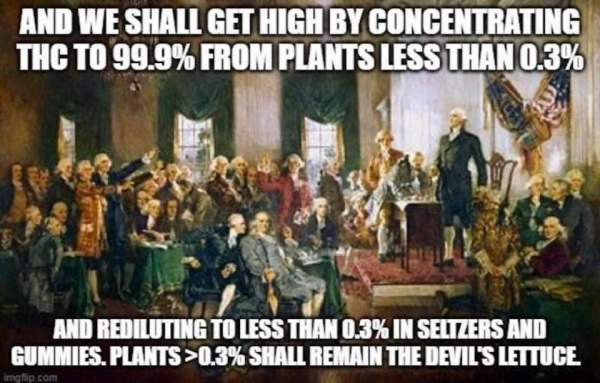
Associating THC with food like drinks and gummies, hemp’s largest current and future market, is short-sighted. We owe accountants and investors at beer and pot companies nothing.
Pot laws have always been hemp’s biggest headache. In fact, “hemp” has always been legally and culturally defined by its lack of THC, yet here we are trying to legalize its unregulated distribution in beverages with a “The Goodness of Hemp” law.
But synthetic THC converted from foreign hemp is merely a cheap, toxic workaround for marijuana prohibition, and delays true Cannabis decriminalization.
Hempnoids have already hurt the legitimate hemp industry substantially in compliance, capital raising, stigma, USDA/NIFA relations, and PR, but with the big dollars involved, more than one hemp association pivoted to stony Hempnoids from grain/fiber (true industrial hemp).
The Goodness of Hemp is a “kitchen sink” approach to the problem at a time when hemp needs moral clarity as much as legal. Medicine belongs with the FDA, more than it does with alcohol and tobacco. If you want to avoid that, then deschedule and allow a patchwork of state laws. If you don’t want FDA approval of meds, then push nonintoxicating noids as a Dietary Supplement and not Schedule 3.
But first, just separate the rope from the dope: bifurcate the industry by end use into industrial hemp (grain/fiber/roots) and drug hemp (Hempnoids, CBD, terpenes) before proceeding further with drug hemp rules.
Only then proceed with the massive number of rules they’ll write to control “hemp THC.”
Leveraging all the goodwill we built over the years just for dirty synthetic THC made from foreign hemp, then mocking us by calling it “The Goodness of Hemp,” is a cruel and ironic ploy.
Cannanomics: Money, Politics and Reform
According to Whitney Economics, the intoxicating hemp derivative market can be twice as large as the state-regulated marijuana market, all done on fewer acres than we have planted to sesame seed. Yet, no regulation, no taxation, no age-gating, and most states have already banned or restricted them.
The study revealed that the U.S. regulated legal cannabis market experienced its first-ever annual revenue decline in 2025, dropping to $29.1 billion. That was likely due to these stony synthetic hemp THC products, as the U.S. consumable hemp-derived cannabinoid market was up to $64.1 billion in 2025, over twice as large… virtually unregulated and untaxed compared to the state-legal marijuana market.
A Yale study suggests that federal legalization would raise $57.9 billion over ten years, and federal plus remaining state legalization would raise almost double that at $0.00625/mg THC via the TTB. But that tax applied to industrial hemp, and it could be as high as $8,000 an acre!
(While they talk taxes, I’m still talking reparations after 89 years of a racist and unconstitutional war on people over a safe, medicinal plant. But I digress.)
It’s not like Type 1 (marijuana/THC) products aren’t available; they’re grown and made in almost every county in the country, plus available via mail order. Making hash and concentrates from flowers is profoundly easy; many safely do it at home.
But businesspeople want you to get all your THC from them, and they want to produce that THC as cheaply as possible; so they convert hemp CBD into dirty forms of THC, throw it in a can with 99.9% sugar water, and call it a day. Then they use those profits to pay legislators to do their bidding by keeping pot illegal. It’s legal bribery, called Lobbying.

These hemp THC workaround laws have the potential to stall true reform like the MORE Act to DEschedule it all, which already passed the House twice in recent years and has 74 cosponsors now. All House and 35 Senate seats were up in November 2026, and the GOP has never been less liked by Americans. It looks like 2027 is the year for change; people are tired of the grift.
But perhaps stalling true reform is the whole point of Hempnoids? Republicans have been against legalization forever; the worst policies in America were their idea (endless wars, war on drugs, and zero-tolerance), and many of the Cannabinoid Cowboys have an “R” after their names. One was smart enough to throw money his way by getting married at the Trump winery this year, which resulted in the President’s measured support. Although the recent firing of Chief of Staff Susie Wiles puts a dent in that; it was her daughter that married.
That’s how GOP politics is done these days, boys and girls: bribery. Hemp advocate Sen. McConnell was a Hemp Hero in 2018, then a Hemp Zero in 2026, because of the Hempnoid ban he passed. Some have called Hempnoids “the MAGA of Cannabis.”
Let’s be honest, the product of the need to pay the rent, bathtub chemistry, and big cojones, THC from hemp really is the biggest BS scam since Sidd Finch, and ten years ago you would’ve doubted it could even happen like it has.
The law didn’t just change in 2018; so did the degree of financial desperation of processors and the amount of CBD biomass stored; the text was the same in the 2014 Farm Bill. And it wasn’t a new process; I read about isomerization decades ago in High Times, and the tech is even older.
The Math Behind Converted THC
But it is “hemp” in name only: delta-8 is in raw cannabis at only trace or “ND” levels, as low as 0.0018% to 0.01%. It would take 55,000 kg of hemp flowers to produce 1 kg of natural phyto delta-8 THC. At $4 per kg for biomass, the cost of raw plant material alone would be $220,000 to make that single kilo of D8, or at least $0.22/milligram! As you’ll read later, it is sold for as low as 2 CENTS per mg, compared to 22 CENTS if extracted, or eleven times more. So it’s obviously not naturally collected, but way easier and cheaper to acid catalyze instead. The process even favors D8 over D9!
They say they get it from mother liquor after removing CBD, but how much CBD is still being made in the U.S. today. Apparently not much, unless they import a lot of biomass, which could also be happening.
Consider the math at the farm level. Hemp at 0.3% THCa could carry as much as 6 pounds of THCa per acre in 2,000 pounds of flowers, and recovering it at that low a concentration is difficult. But there are also 6 pounds of THCa in just 20 pounds of 30% marijuana flowers: 2,000 vs. 20. At $1.20 per gram for THCa isolate on the open market, 6 pounds (about 2,722 grams) is worth roughly $3,266 per acre, or about $2,286 at a more realistic 70% recovery, before the cost of extraction. That is a lot of extra work to get 0.3% THCa trichomes from hemp instead of 30% THCa trichomes from marijuana, literally 100 times less efficient.
While the CBD content would reveal the truth in the raw material, once purified all we get is THC plus the environmental contaminants concentrated by a species notorious for remediating whatever is in the soil. One major Hempnoid producer was sued by the Colorado Attorney General, and the settlement cited misrepresentation of “the source, quality, characteristics, ingredients and/or health benefits” of its products, as well as falsely claiming to operate in Texas when it operated solely in Colorado.
I suspect “our D9 THC comes from 0.3% THC hemp trichomes” is today’s “our CBD comes from the hemp stalk.” What’s the difference? Quality. Maybe chirality. Definitely integrity. At least call it “tHc,” for hemp THC, or “HTHC.” Truth-in-labeling is a Thing; ask a tort lawyer or the FTC.
But from a purely chemical standpoint, you can’t tell the difference between CBD or minor cannabinoids extracted from industrial hemp versus those extracted from high-THC marijuana, which is anything over 0.3% THC when dry. So we are left to trust nameless, faceless businesspeople somewhere that they are not lying, scout’s honor.
Telling Plant THC from Converted THC
However, chirality is a useful diagnostic tool to discern converted THC from phyto. While natural THC and the converted version both start with the same “left-handed” backbone, the conversion process introduces spatial anomalies that labs use to tell them apart.
Because manufacturers start with natural, plant-extracted CBD to make converted THC, the starting material is already 100% pure (-)-trans-CBD. When an acid catalyst is added to close the open chemical ring of CBD (a process called isomerization), it preserves that specific “left-handed” configuration. Therefore, both natural THC and converted THC are predominantly (-)-trans-D9-THC. They share the exact same major enantiomer, meaning they are not total mirror images of one another.
The difference lies in a different type of chirality called diastereomerism (the cis vs. trans orientation of the molecule). The cannabis plant possesses highly specialized enzymes that fold the molecule with extreme precision. Natural THC is almost 100% trans-THC; it features practically zero cis-THC variants.
A laboratory chemical reaction lacks the absolute spatial precision of a living plant’s enzymes. When the acid catalyst forces the CBD ring to snap shut, the reaction is somewhat chaotic. This creates unintended stereochemical side products, specifically (+/-)-cis-THC isomers.
When a laboratory runs a sample through a specialized testing machine (like a Chiral HPLC), they look for these specific “chemical footprints”:
1. The Presence of Cis-Isomers: If a cartridge or edible contains measurable amounts of cis-D9-THC or cis-D8-THC, it is a dead giveaway that the product was chemically converted from hemp rather than extracted naturally from marijuana.
2. Unnatural Exo-THC and Byproducts: The harsh acid environment of chemical conversion also shifts double bonds to unnatural positions, creating synthetic artifacts like Δ10-THC, Δ6a,10a-THC, or “exo-THC” that do not appear in meaningful amounts in a natural Cannabis plant.
So, while the primary “high-producing” molecule remains structurally identical in both, the imperfect spatial chemistry of laboratory conversion leaves behind unique chiral “fingerprints” that an advanced lab can easily spot.
But the cis version of THC does not affect the body’s receptors the same way as the trans version. Because human cannabinoid receptors (specifically CB1 and CB2) are highly shape-sensitive “locks,” changing the spatial orientation of the molecule from trans to cis alters how tightly the molecule fits into that lock. This directly impacts both binding affinity and psychoactive potency.
A breakdown reveals how cis-THC differs in its interaction with the body:
1. Significantly Weaker Binding Strength. The human CB1 receptor, primarily located in the brain and central nervous system, is responsible for the psychoactive “high” of THC. (-)-trans-THC (natural THC) binds perfectly into the receptor’s pocket, acting as a potent partial agonist. (-)-cis-THC, the naturally aligned left-handed cis isomer, binds to the CB1 receptor roughly 10 times weaker than natural trans-THC. (+)-cis-THC binds up to 100 times weaker because its tricyclic scaffold is essentially reversed; it struggles to sit correctly in the receptor pocket.
2. Drastically Lower Potency. Because the cis isomers cannot bind efficiently, their overall pharmacological effect is severely muted. In animal models measuring the classic “cannabinoid tetrad” (the physical benchmarks used to test THC’s intensity, like hypothermia and pain relief), (-)-cis-D9-THC is estimated to be only about 1/5th as potent as standard trans-D9-THC.
To get the same physical or psychoactive response from cis-THC, a user would theoretically have to consume a significantly higher dose. When manufacturers convert CBD into D9 or D8 THC, these weaker cis byproducts are created by accident due to the chaos of chemical manipulation. Because cis-THC variants have a lower binding efficiency, a vape cartridge containing a significant fraction of cis impurities will feel noticeably less potent and lower quality to a consumer compared to a clean, natural trans-THC extract from a dispensary, even if the label claims a high overall “THC” percentage.
However, one reliable method to discern between converted and natural THC is with a chromatogram, the visual graph generated by testing equipment like an HPLC; the difference between natural and converted THC is completely distinct. Instead of looking at the molecule itself, the technician looks at the number of peaks, the retention times (when a peak appears), and the overall “cleanliness” of the graph.
An advanced liquid chromatography (HPLC) or gas chromatography (GC) machine pumps the sample through a tightly packed column. Different molecules stick to the column material with varying intensity, causing them to show up as sharp peaks on the graph at different times.
A natural THC chromatogram is remarkably clean because a natural plant relies on precise enzyme synthesis; it produces sharp, clear peaks for the exact compounds it intended to make. You will see a massive peak for (-)-trans-D9-THC and perhaps minor, organic peaks for standard compounds like CBD or CBN. The space around the THC peak is pristine because there are no cis-isomers or synthetic byproducts present [PDF].
But a converted THC chromatogram looks crowded and messy because chemical acid conversions are chaotic, they leave behind “chemical footprints.” Alongside the main D9 THC peak, a cluster of unexpected, secondary peaks appears directly before or after it. These are the (+/-)-cis-D9-THC variants, D8-THC, D10-THC, and synthetic artifacts like “exo-THC”.
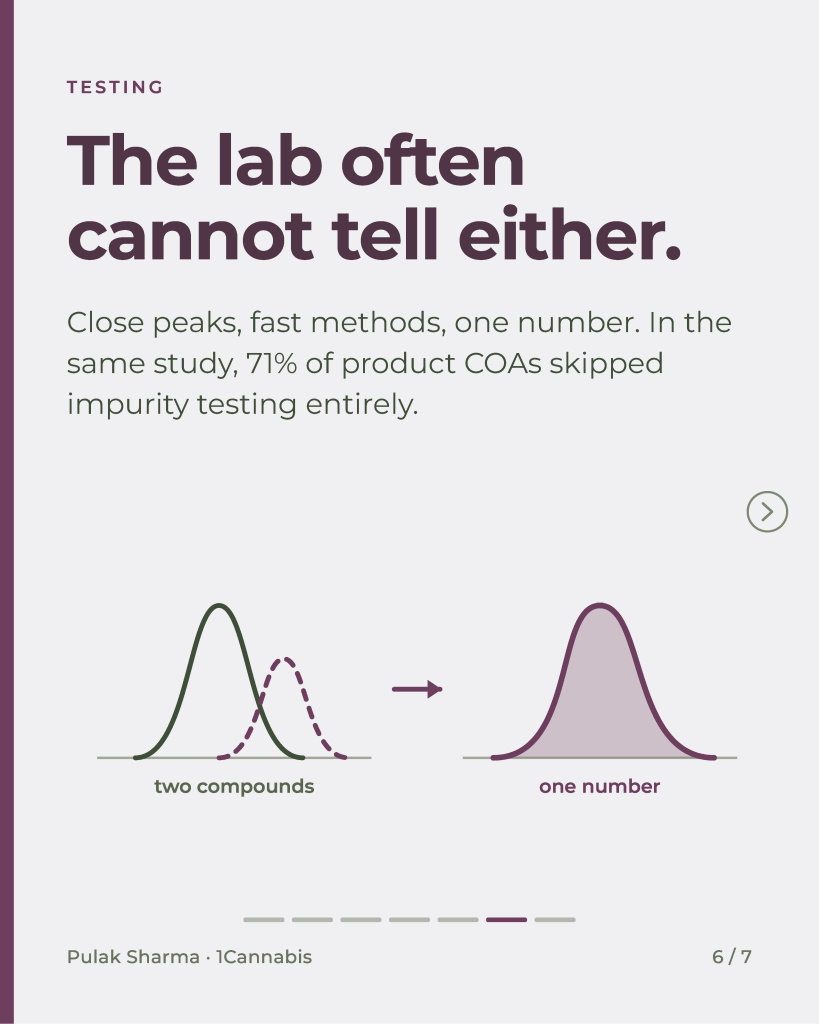
A standard lab test only measures total potency and often lumps cis and trans variants together [PDF] as one big peak. To truly reveal converted THC, labs use a specialized Chiral HPLC Column. A chiral column acts like a “three-dimensional racetrack”. The internal lining of the column contains specialized left- or right-handed molecules (like amylose or cellulose).
As the converted sample travels through, the trans molecules fit into the lining differently than the awkwardly shaped cis molecules. This forces them to separate into completely distinct retention times. The resulting chromatogram will explicitly split what looked like “pure THC” into two or three separate peaks, proving the presence of unnatural cis stereoisomers.
One can then look at a chromatogram printout and immediately know the source: one isolated, clean peak means it came from a plant; a cluster of overlapping, uninvited “ghost” peaks means it was synthesized in a lab flask.
And these were not farmers pivoting slightly to an additional revenue stream; they were chemists allergic to dirt, synthesizing THC analogs inferior to God’s own from foreign hemp… more Breaking Bad than Green Acres. While I used Irrevocable Letters of Credit for real industrial trade, I wouldn’t be surprised if the wholesale side was essentially an all-cash business, using crypto, the currency of crime. They would be crazy not to, frankly.
China: America’s THC Plug
Which country’s farmers benefited the most from U.S. hemp legalization in 2018? China, the raw material supplier, cheapest CBD on the planet. There are 795 suppliers of the raw material CBD Isolate on Alibaba.com, the “Amazon of China.”
In “From Import to Intoxicant: How China Exploited the Farm Bill ‘Loophole’ and Helped Fuel America’s Synthetic THC Market,” it says “[i]ndustry participants reported heavy reliance on imported CBD inputs as the synthetic THC market took off, particularly from China, with one industry leader claiming that Chinese imports account for 70% of the CBD used to create synthetic THC products. This imported CBD serves as the chemical foundation for a $2.8 billion synthetic THC industry, yet arrives without testing, documentation, or any regulatory oversight.”
I remember back in the early days of CBD commerce, 2014, there were many reports of people new to international business attempting to source tons of CBD, billions of dollars worth, but they had no understanding of anything. Such as a yoga instructor in LA, never before in business, sourcing $6 billion worth from anyone who would answer her pleas. I think it was China doing market research, as one would expect before entering a new market with a new material. Even today, marijuana black and regulated markets have Chinese national presence, globally.
People don’t realize how advanced China is in hemp and Cannabis in general. Although a notoriously secretive nation, patents tell the story; they are quietly working on projects we won’t get even a whisper of until they are ready. The nation from which it is believed fiber hemp first arose, and unlike every other nation, it did not go away in all these years hence, nor was it stigmatized. In fact, the Chinese are the largest consumers of hempseed as food, a billion people still eat it like their ancestors have for millennia as a snack, sold on the street.

When I sourced whole organic hempseed to shell to make HempNut and foods therefrom in 1996, I bought hundreds of tons from China at $0.25 per pound FOB Harbin. Nonorganic was even cheaper, $0.15 per pound. A few years later, Canada was selling whole seed for almost three times more, nonorganic. Because it takes 2.5 pounds of whole seed to get one of shelled, any price advantage on the input is magnified on the output. I was able to sell organic shelled HempNut for less than their cost of production of nonorganic, all thanks to my global supply chain starting in China.
As the largest producer of hemp in the world in the north, and possibly the largest cannabinoid producer in the south, and with a 5,000-year history of Cannabis as a medicine, a large number of acres at the right latitude and low-cost production, China owns the future of hemp, wherever we in the West might want to take it. They’ll adapt, such as expanding production to Africa and South America, where they have partnerships via their Belt and Road Initiative.
And likely with cannabinoid medicine as well: it is also the largest producer of Active Pharmaceutical Ingredients (APIs) in the world. They are wise enough not to let anti-traditional and natural medicine treaties stand in their way, even if a signatory. National opacity has its advantages.
In an analysis by the World Intellectual Property Organization (WIPO) of early foundational cannabis-related patent families, Chinese firms held about 51% (309 out of 606) of those international filings. Those have claimed rights to everything from traditional Chinese medicine-related marijuana tinctures to new methods of administering the drug, like a film that sticks to the skin. And with China’s massive and ambitious Belt and Road Initiative, expect to see more Cannabis projects in nations in tropical latitudes, in addition to hemp in the southern hemisphere.
But on July 8, 2026, Fox News sounded the alarm: “Former acting Homeland Security Secretary Chad Wolf sent a letter to House lawmakers Tuesday urging them to investigate the “growing role that Chinese-linked actors and foreign criminal organizations are playing in the proliferation of hemp-derived tetrahydrocannabinol (THC) products and illegal marijuana operations” in the U.S., which he says are “putting our youth and adults at risk.” “Beyond the serious public health implications, there is mounting evidence that this issue also presents a significant national security concern.”
“What began as a narrowly tailored effort to legalize industrial hemp and non-intoxicating cannabidiol (CBD) products has evolved into a dangerous and unregulated market for high-potency THC hemp products that are being sold across the country with little to no oversight,” Wolf wrote. “These products are frequently marketed as gummies, candies, beverages and vapes, often packaged and promoted in ways that appeal to children. They lack acceptable age restrictions, labeling requirements and safety standards.”
Wolf cited a warning from the White House’s 2026 National Drug Control Strategy, which described how “the marijuana trade in the United States is no longer a scattered, low-level problem; it has been co-opted and industrialized by sophisticated, transnational criminal organizations, particularly those with ties to China.”
In “HIGH CRIMES – The Chinese Mafia’s Takeover of Rural America,” the film revealed how hemp licenses and regulations serve as one of the primary legal loopholes exploited by transnational criminal syndicates. The documentary highlights how organized crime groups systematically abuse the 2018 Farm Bill to mask massive, illicit marijuana operations.
The documentary highlights a leaked Department of Homeland Security (DHS) memo identifying more than 270 to 400 illicit hemp properties tied to Asian transnational criminal organizations in Maine alone.
How cheap are Chinese hemp cannabinoid products? This cheap, here is the sales offer from one Hempnoid company located in a state that bans the retail sale of them [bold is mine]:
“This is [redacted] from [redacted]!
I wanted to check in to see if you’d be interested in the lowest-priced cannabinoids in the hemp industry, with no MOQs [Minimum Order Quantity]. Please check out the prices per kg:
Drinks
Converted D9 – as low as $475/kg
Natural D9 – as low as $1,000/kg
D9 Water-Soluble – $800/kg at 15% (clear & tasteless)
Non-Psychoactive
CBD – as low as $250/kg
CBN – $950/kg
CBC – $2,000/kg
CRD – $400/kg
THCV – $2,750/kg
Psychoactives & THCa
THCP – $2,750/kg
DD8 [delta-8] – as low as $230/kg
HHC – $440/kg
THCa Isolate – $1300/kg
THCa Live Resin Distillate – $3,000/kg
THCa Live Rosin – $4,000/kg
THCa Live Resin – $3,000/kg
THCa Crumble / Badder – $2,500/kg”
What Converted THC Costs
The market is already voting. Hemp Benchmarks reported in its August update that, with the federal ban’s hard 0.4 mg total-THC cap looming, extractors are heavily discounting distillates and isolates in bulk, driving raw material valuations down across the sector. CBN isolate and CBD distillate saw the largest erosion in August, down 19.6% and 17.4%. CBD isolate fell for a third straight month, down 6% (nearly $20 per kilo) and 34% year over year.
Looking at the cost to grow one pound of commercial Type 1 flowers (marijuana) outdoors at say $50.00, the cost of one ounce of flowers is $3.13, with 20% THCa in the flowers, that will provide 5.67 grams of THCa per ounce of flowers.
That phytocannabinoid comes out to $0.55 per gram of THCa, or $551.15 per kg. Compare that $551 to what is being sold above: Phyto D9 THC is $1,000, and D9 isomerized from hemp is $475.
Be honest: would you pay 16% more for a raw material that also takes more time and hassle to generate? Neither did they. Although natural phytocannabinoids would give any brand marketing differentiation in a sea of synthetics, Marketing is still a mysterious art to most, especially Marketers, it appears. (BA in Marketing 1989 + MBA concentration in Marketing 1992 here.)
While state-regulated pot companies won’t be able to match that $551 per kg for phyto THCa due to the taxes and regulations driving up costs, other nations or those in the gray market can.
Either that, or Hempnoid producers can pay those same taxes and labor under those same rules and regulations, in order to level the playing field. And ultimately, the only fix for any of this is decriminalization of all Cannabis federally and in each state, to eliminate these synthetic workarounds for prohibition.
Since CBD is the precursor chemical for these intoxicating hemp drugs, it got caught up in the intoxicating Hempnoid ban by Congress, the only tool it has. Delta-8 killed CBD.
And to the “Cannabis is not toxic” crowd: either this synthetic stuff is Cannabis and it hurts people, or this synthetic stuff that hurts people is not Cannabis: take your pick but you don’t get both. So yes, “intoxicating synthetic hemp drugs.”
The Science: Synthetics and Prohibition
Esteemed Cannabis scientist Ethan Russo makes clear that these toxic synthetics would not exist but for marijuana prohibition (bold is mine): “[T]he synthetic cannabinoids that have been available are, generally speaking, what I call full CB1 receptor agonists, in contrast to THC. THC is what is called a weak partial agonist. Now let me explain what I just said: if we think of the receptors as locks and the substance as the key, we want a good fit. With THC, this is a weak connection. And that’s how nature works. THC is like anandamide, which is also a weak partial agonist, whereas these synthetic cannabinoids bind extremely strongly [to the receptors] and so they are what I call full agonists. They can often be 10 to 100 times more potent than THC. So, right away, this is too much. Just as an excess of THC produces paranoia, anxiety, rapid heart rate, these are much worse, because they not only affect the CB1 receptor, but also often have what are called “off-target” effects. Some of these synthetic cannabinoids can be directly toxic to the heart, liver or kidneys. So it’s unfortunate that one woman died, but there have been other deaths caused by synthetic cannabinoids.”
“What I can say is that people shouldn’t use them. However, I repeat, these products exist because of the ban, because of the profit of those who manufacture them, and many of these things come from China. There is no quality control involved. The problem is that if we make them illegal, people will still use them. Prohibition doesn’t work. We actually had a situation with Delta-8 THC in the United States. Some people believe that synthetically produced material, transforming CBD into Delta-8 THC, is legal. No state should be promoting the use of these substances, because Delta-8 that is made synthetically always has contaminants, other cannabinoids or other substances, and is made with solvents that cannot necessarily be purged entirely from the material. But, once again, I believe there would be no trade in this synthetic Delta-8 if cannabis were legal and regulated,” said Dr. Russo.
“[W]hy do synthetic cannabinoids exist? They are a byproduct of prohibition and the main reason people use them is because they don’t show up on drug tests. But these are not controlled and are generally very dangerous. THC, being a weak partial agonist of the CB1 receptor, binds to the receptor, but it’s a small nudge, not a big push. In comparison, synthetic cannabinoids tend to be full agonists and are extremely potent at the receptor. Additionally, they have many “off-target” effects that may have nothing to do with the CB1 receptor. Thus, these drugs have been associated with heart damage, kidney damage and some deaths. They are simply dangerous, unnecessary, and I think this industry would wither and die if cannabis were legalized and available in a regulated manner.”

Worse still: domestic farmers don’t benefit.
Associating hemp with THC is a bad look and will come back to haunt us; all for a segment forgetting why beverage bottlers are regional. Transporting 340,200 mg (12 oz) of mostly water just to get 10 mg of THC is not a sustainable business model. And it is just waiting to be disintermediated by say a dropper product form or other dosing delivery system, turning every soda into an infused one, every bar into a THC Tavern, every restaurant into a stony infused dining experience, no watery drinks or beer distributors needed.
Getting people high on THC is not hemp’s fight; we have our own problems that The Goodness of Hemp doesn’t even begin to address.
Low-dose THC does not equal “hemp”; it could be from the glut of inexpensive 15-25% THC Type 1 flowers on the west coast. Harvesting 0.3% THC trichomes when 30% THC ones are available next door is plausible but ridiculous.
Given the choice between smoking a plant or synthetic chemicals, few would bother with vaping God-knows-what grown God-knows-where and processed God-knows-how. Hempnoids are an accidental regulatory anomaly exploited by desperate processors.
And day by day, it is making the “H” word toxic to politicians, big ag, and big business. From one California hempster: “Last year they were one of the top lobbyists in Sacramento when they were writing the law. Our local Senator said it was such a joke with [redacted to protect the innocent whom the guilty would sue] and [redacted to protect the innocent whom the guilty would sue] trying to educate everyone that HEMP THC 10-20 mg drinks and gummies were legal industrial hemp, that lab-made hemp THC was legal. They made a mockery of hemp. The cannabis lobby jumped on it hard and tag-teamed with Newsom. It was just a bloodbath, no hemp farmers were there. It was just all the THC bros. I asked to go up and help lobby but they wanted $10k for me to be there… even though I was a plaintiff in the lawsuit. And they really pissed off all the cannabis lobbyists and companies.”
The Cult of Hemp and the Testing Double Standard
The “green rushers” back in 2019 turned an already active and thriving international hemp industry into a Cult of Hemp, complete with exclusive gatherings, preferred dogma, self-appointed leaders, dodgy icons and slogans (turns out they weren’t actually for better alternatives), and excluding all but The Loyal Worthy True Believers in their performance called business. Competing hemp expos were quashed. Hempcrete became a religion.
They were also the Perfect Republicans: #nocrimesmatter, favoring feel-good lies over real truths, turning political identity into their whole being. Controlling the narrative to the disadvantage of all but them, no lie was too big to fail. So instead of the lie failing, hemp did.
After pushing out the good ones, all that was left at expos was noobs and those who prey upon them. It was a perfect storm for fraud and financial disaster on a large scale, and it was completely foreseeable; most hemp elders and OGs stayed away. The cult demanded biomass, so it got it. Lots and lots of biomass.
Either regulate marijuana like hemp or regulate hemp like marijuana. While the current state of marijuana regulation in the states is a sad, bad joke, with open and flagrant THC inflation fraud and the tacit approval of regulators, THC testing of live hemp in the ground is highly controlled: a law enforcement officer or registered agent collects the sample and delivers it to a state drug lab, maintaining legal chain of custody in case of federal prosecution over literally tenths of one percent THC, as 0.3% THC is compliant but 0.4% isn’t.
That’s 100-times less than the THC percentage many claim for marijuana, yet the sample of it is handled like it was a Schedule 1 controlled substance worthy of prosecution. Meanwhile, the actual Schedule 1 controlled substance, raw marijuana, is a Wild West, anything-goes sample-collection technique: some dispos microwave it to kill mold, roll it in kief to increase THC %, then send it off to the lab as a legit sample.
“Last week, Richard Rose, a legend in the hemp world and author of The Richard Rose Report … This Week newsletter on the subject, mocked the general state of his industry: ‘We tell them we want to feed and clothe people so they legalize and then we end up making dirty bathtub THC for vape pens to be sold to teens in southern states. There’s a huge lesson to be learned from all this,’ Rose wrote. ‘Either regulate marijuana like hemp or regulate hemp like marijuana.’”
Why “Hemp THC” is an Oxymoron
The Goodness of Hemp is a misguided attempt to make hay on the newest and most profitable emerging segment ostensibly from hemp, which completely depends on a misread loophole for its existence.
Integrity matters, even today, in the age of MAGA (“Make America Grift Again”).
“Hemp” and “THC” shouldn’t even be in the same sentence. Call it what it is: a THC product or a Cannabinoid product or a Cannabis product, but leave hemp’s good name out of it. They use it solely for regulatory obfuscation and marketing cover.
“Hemp THC” is a consumer fraud and a regulatory workaround exploiting a tiny loophole. There is no reason to call it hemp except to borrow a patina of respectability, renting a halo from hemp fiber, hempcrete, hempwood, hemp oil, and hemp seed.
We don’t call beer “intoxicating barley,” wine “intoxicating grape,” vodka “intoxicating potato,” or whisky “intoxicating corn.” So why call bizarre synthetic THC, chemically converted ostensibly from CBD, “hemp”? Call it “tHc,” “HTHC,” “THCx,” “Altnoids,” or just what it is. Lose “hemp,” and gain our support.
This is not an anti-THC screed; over the last 55 years, few have maintained good health thanks to THC for as long as I have. It is truly a miracle molecule without which I would not be here today.
But it is not hemp, and hemp is not a good source of THC whether collected or converted, and “hemp THC” is an oxymoron bordering on fraud, delaying true reform.
Ironically, they didn’t even need the 2018 Farm Bill to pull it off; that same definition was also in the 2014 Farm Bill. But the next Farm Bill could end it all.
Hemp Associations and Narrow Advocacy
Associations have long proven to be the main impediment to normalizing hemp. Today is no different.
Success for hemp in America requires the one thing Americans are bad at: cooperation. For the three decades before the 2018 Farm Bill, the industry was built on cooperation; afterward it turned competitive, and competition killed it. (See Riane Eisler’s partnership/dominator model of how cultures evolve.)
“Americans can always be trusted to do the right thing, once all other possibilities have been exhausted.” —Churchill

We have paid for this lesson before. Over 25 years ago, the most popular hemp products in the country were taken off the market for years, also due to a hemp association. That almost took Canadian hemp down with it, and it took over a decade to recover. Legalization then took until 2018 because the advocates were sponsored by those with investments in Canadian hemp.
Today, hempseed is hemp’s largest market, in every supermarket in North America and Europe. The lesson was learned: narrow special-interest advocacy hurts us all.
Associations opportunistically popped up in 2019 like mushrooms, and for the same reason. Unable to provide value, they became promotional vehicles glorifying their members. Ironically, the one hemp association that provides the most value is the only one that has never charged dues in its 28-year history. Associations often forget that their stakeholders include more than those who pay them thousands of dollars; they are a small part of a large, established ecosystem, not its whole universe.
To control the information, they kept the smartest and most accomplished people in the hemp space off the stage in favor of noobs and hustlers, and that’s how we got a 95% crash in acres in just 5 years. People were sold a lie: profitable only to a few, namely those selling it.
Hempseed Food: The Market Worth Protecting
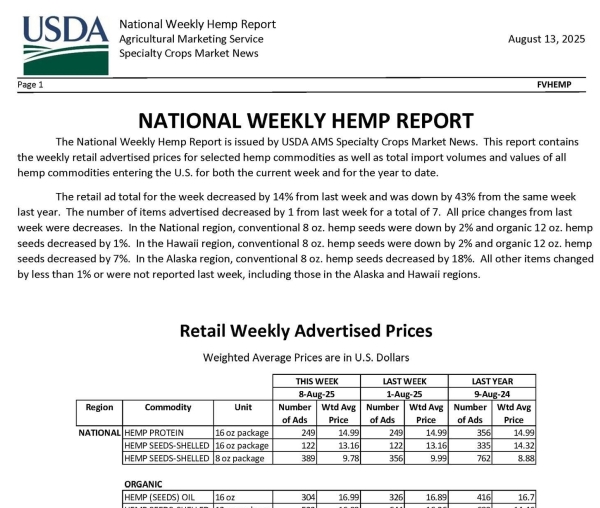
Contrast all that to hemp’s largest and most profitable market, currently and for the last 30 years: food from the grain. It’s such an important market that USDA has tracked its prices weekly for years.
With seed in every supermarket in North America and Europe, food is the only proven and validated success in hemp, replicated across the globe. It also ties in neatly with trends in food, such as plant-based, omega-3, protein-rich, low-cost, food security and independence. And with new discoveries in the medicinal and technical properties of the seed monthly, it has substantial upside as an ingredient in commercial foods as well as functional, medical, wellness, and others.
Hemp is the red-headed stepchild of Cannabis, and food is also that within hemp. Few hemp fans appear even to know what hemp’s biggest market or product is, or why it is the key to finally making hemp successful in the U.S.

A Movement raised on the Victim Narrative ends up unintentionally creating that reality as a default, so fixated on failure it becomes. A Movement raised on success does not.
That’s why you never hear about hemp’s most successful product, only the unapproved and expensive ones. You hear about the ban on “hemp THC” but not the success of hempseed medical research; you’re told you can no longer buy “hemp THC” but not that you can buy hempseed food in any supermarket.
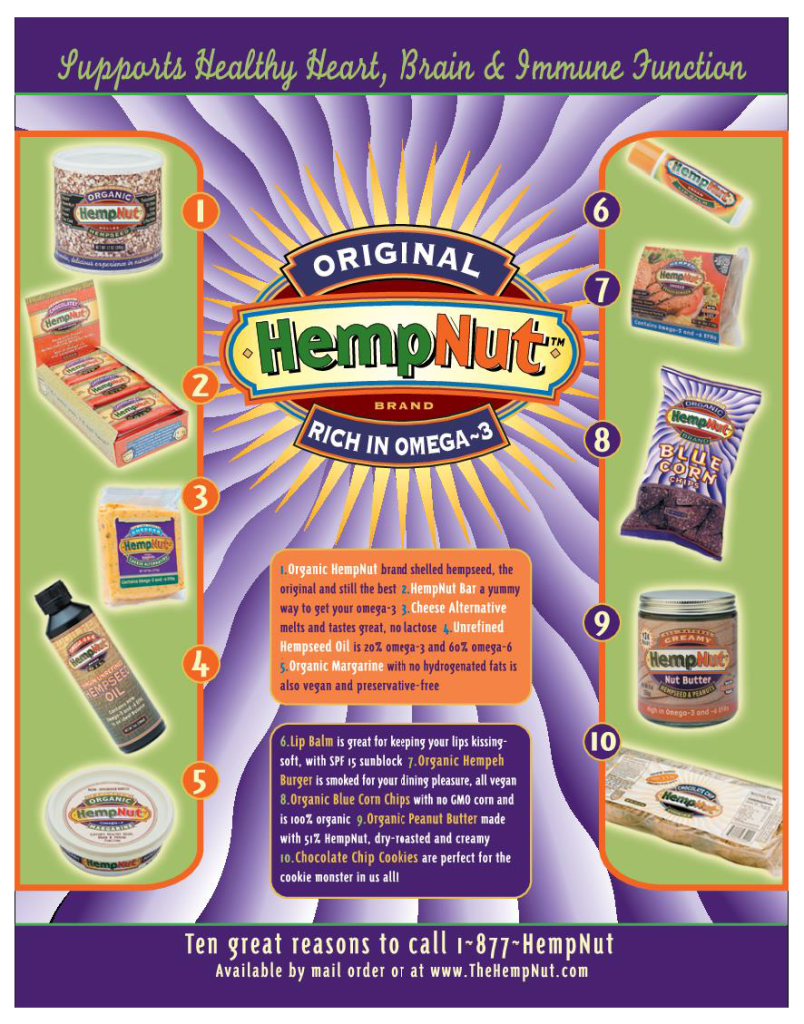
With HempNut, Inc., I intentionally didn’t play the Victim Narrative card. We focused on my vision of commercializing shelled hempseed, as I did previously with soya, a success. Wholesale buyers didn’t want to hear a whiny pitch; they wanted to hear how hemp foods were going to make them money. Y’know… be successful. And it worked: that same type of product is now 100% legal and sold globally, hemp’s first billion-dollar sector.
The “hemp industry” is really two: primary production and processing. The big money is in the processing, but without production, nothing gets done. So then the question becomes one of cost vs. hassle.
In today’s globalized economy, companies need to create a new supply/distribution chain model which leverages exclusive assets such as brands, reputation, or even location. But in hemp, branding is an afterthought if any is given at all.
What I spent 32 years and $2.5 million doing wasn’t to legalize dirty forms of THC in vape pens, but rather, the domestic production of industrial hemp, waving fields of grain.
We didn’t legalize to have a robust hemp products industry, we already had that in spades; it’s just that we wanted it to drive U.S. acres, not Chinese and Canadian.
Food is also the easiest hemp segment to get into, requiring no farm, factory, or finances when done right. And it has a 3-times greater impact on reducing greenhouse gas than hempcrete, and 11 times more than EVs.
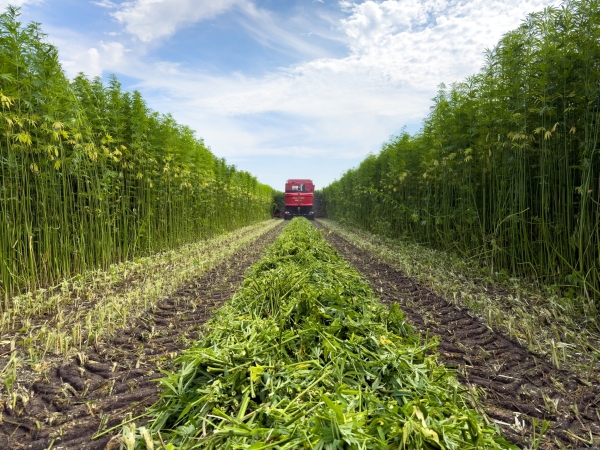
Growing grain is true industrial hemp, broadacre, thousands and thousands of acres, millions of seeds. This is what I have been working to legalize in the U.S. by making hemp products popular since the last century.
Farmer co-ops, rotation crops, machines drilling and harvesting, drying, shelling, making branded foods for humans. Grain does that and more: it generates at least 4-times more weight in stalks for bast and hurd fiber uses, the rare hemp Win-Win. But it is a zero-sum crop: if they grow for CBD then they can’t grow for grain or fiber.
Feeding people is a noble effort that can fund the farm, and it is one of the least expensive protein foods around.
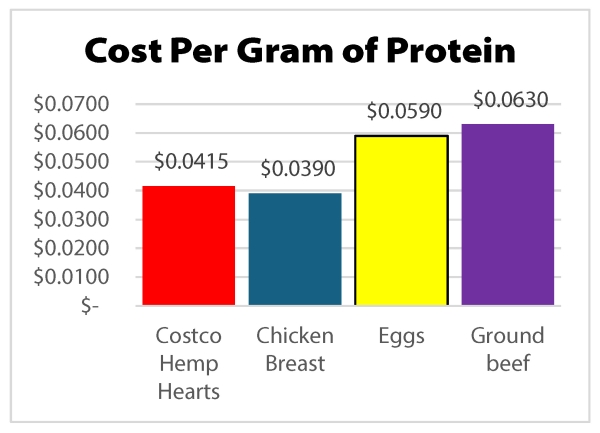
The cost of protein from ground beef averages about $0.063 per gram. Chicken Breast: $0.039 per gram. Eggs: $0.059 per gram (depending). But Costco Hemp Hearts are $5.85/pound @ 31% protein = $0.042 per gram of protein. That market, driving acres, sales, and profits in many nations, is now in danger of getting an undeserved association with THC from proposals like The Goodness of Hemp.
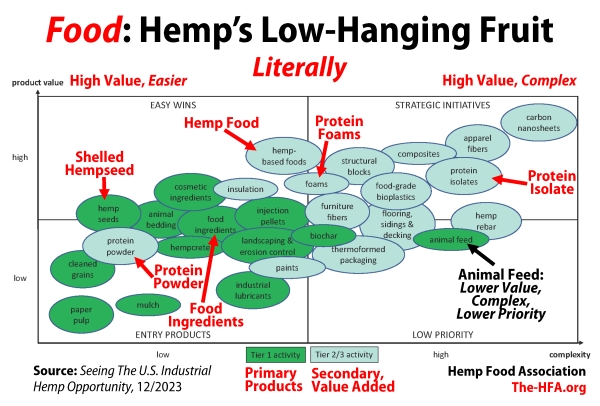
I’ve written before in response to another report, “Seeing The U.S. Industrial Hemp Opportunity” (2023), by IND Hemp of Montana. My bottom line: grain as food for hungry mouths is literally the low-hanging fruit for hemp success in America. Too bad everyone is trying to get high as cheaply as possible instead.
As we’ve seen so far, USDA and NIFA won’t touch the production of hemp grain for food until this Hempnoid issue is settled properly, despite “food” literally being in the National Institute for Food and Agriculture’s name.
In moments like these, we can take the easy path or the harder one: aim for quick, easy bucks or improve society for everyone instead.
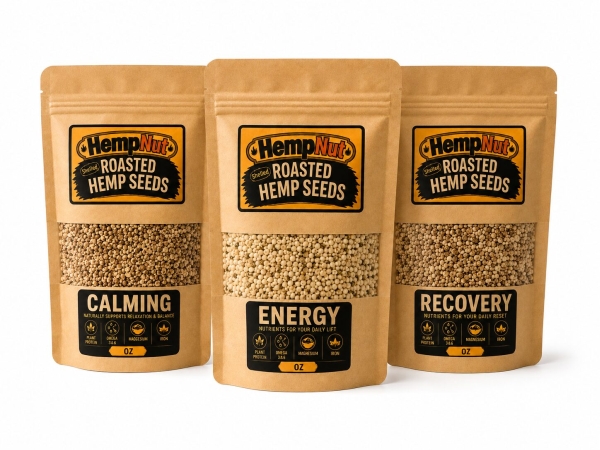
Personally, I haven’t worked to legalize since California’s Prop 19 in 1972 just for opportunists to synthesize dirty THC from foreign hemp all under the bullshit rubric of “hemp,” while leaving the plant Schedule 1 for the rest of us.
Nor did I spend $2.5 million to make hempseed food a Thing literally in the last century, just for that “goodness” to now be co-opted for THC. But that’s just me.
In our zeal to drive the future, don’t forget our past. How we got here and why, who got us here and how… there’s a robust history of hemp product success in America, not even including the hundreds of thousands of acres of ditchweed.
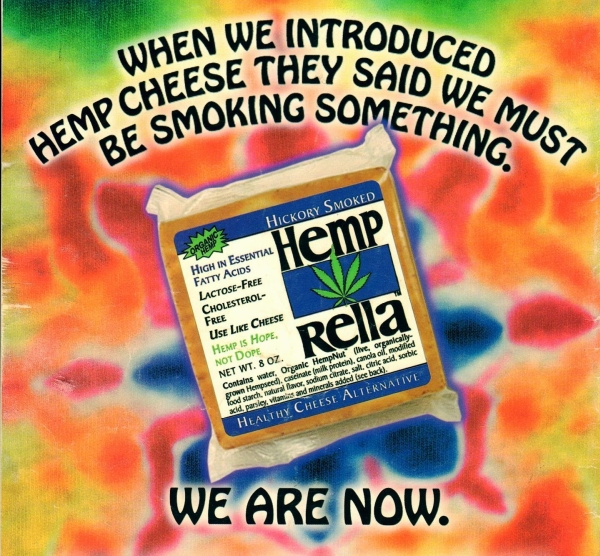
And those people are still around but won’t spend their own money to educate you like they’ve been doing for decades already. That leaves noobs in the hands of scammers, and it shows when the goodness of hemp is tainted to pimp THC.
None of this is what we worked for even a year ago, legalizing hemp THC. The Goodness of Hemp Act is an utter betrayal of every hemp activist ever, just to enrich a few conservatives while delaying true cannabis reform.
What Hempseed Food Needs from Congress
The hemp food segment needs legislation too. It is the largest legal hemp market, with grain in every supermarket in North America and Europe, driving acres, sales, and profits for mostly foreign farms. For better integration with the commercial food industry, we need regulations that give it greater credibility and stability, especially after the current fiasco of THC food sold in gas stations to teens labeled “hemp”:
1) Mandate use of certified seed sown broadacre to reduce regulatory risk;
2) Since that seed is government-certified to be low in THC, require no THC test and no farmer background checks or fingerprinting;
3) Change the maximum THC for foods to 10 ppm, to be compliant with Canada. Currently it is 3,000 ppm (0.3%), or 300 times higher;
4) Allow a “No THC” or “THC-free” label declaration for products compliant at 10 ppm;
5) Allow “hempnut” as the common and usual name for shelled or dehulled hempseed, to save label space and establish it as a distinct product. Botanically, the seed is a nut from the hemp plant. (“Hemp Hearts” is a brand name and trademark of a Canadian company);
6) Have USDA issue grants to expand production and regional processing;
7) Approve hempseed for the National School Lunch Program and federal institutional feeding;
8) Mandate that federally funded infrastructure projects use at least 5% biomaterials, such as hemp fiber products; and
9) Approve hemp grain as animal feed and fodder, so sub-standard material has a non-human home.
Hemp clothes and food have no THC in them. If the proposal impugns us, at least give us an upside: the laws we need in order to flourish too.
Suggestions and Bottom Line
I could discuss this aspect or that policy, there are good ideas in The Goodness of Hemp Act for sure and many that we’ve been on about for years, decades even, such as 1% max THC, not treating farmers like criminals, allowing drug felons, USDA/NIFA grants, etc.
But the bottom-line is this:
“Hemp THC” will be the death of the normalization and integration of industrial hemp in the U.S.
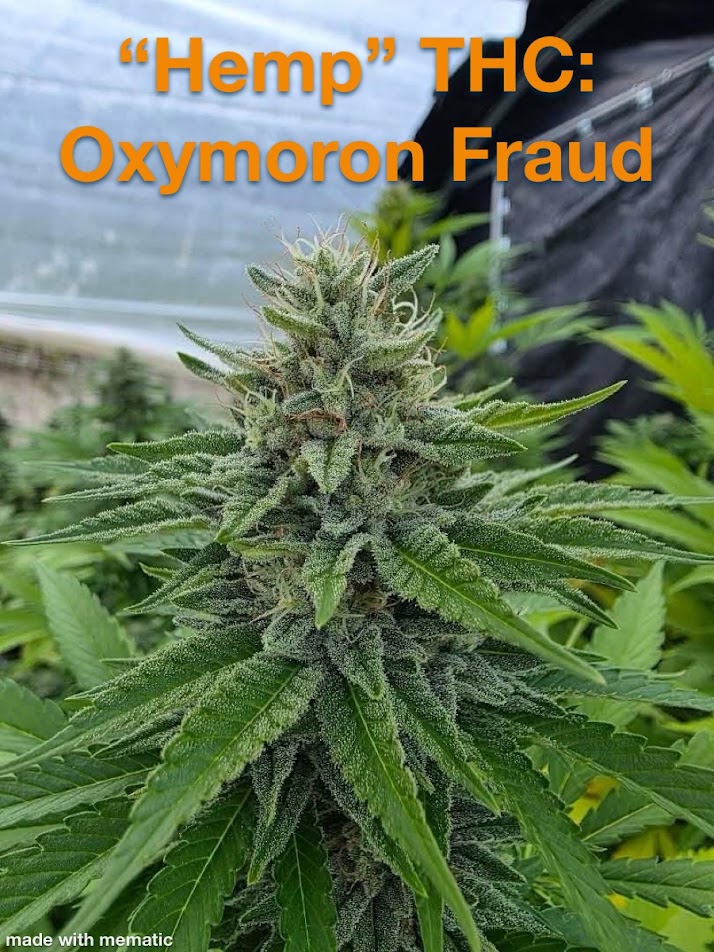
Every bad thing associated with unregulated THC in the mass market will be called “hemp.” Then we’ll get national headlines such as “Hemp Kills 5 in Crash” and “Pilot High on Hemp Arrested” and “Should Hemp Be Banned?” and “Hemp Hurting Our Teens!”
And any recall of a THC drink will carry the headline “Hemp Drink Recalled.” Disassociating hemp from THC is imperative for the hemp industry, beer execs and cannabinoid cowboys be damned.
Farmers will once again snicker when it’s mentioned. Wholesale buyers will say NO! before you even open your mouth about a new hempseed corn chip or bread. Legislators won’t return phone calls and USDA will try to avoid it like they have since legalization. It will never become the normal agricultural crop we’ve worked toward for decades.
And perhaps that’s the point? Twenty-five years ago hemp association leaders pushed back on legalization and normalization in the U.S. because they had investments in Canadian hemp. What investments in “hemp THC” do today’s leaders have, thus willing to sacrifice industrial at the Altar of the Cheap Stone?
The President of NHA and the main proponent of the proposal is a Canadian former racing executive, not an American farmer, and works closely with CHTA, the hemp association up there.
Reading the Goodness of Hemp Act of 2026
Here is the official summary of it:
The Goodness of Hemp Act of 2026
Executive Summary | Version 10.J | September 18, 2026
“What it does
Creates a permanent federal framework centered on American hemp agriculture and industrial markets. USDA governs cultivation, industrial-only and dual-use production, testing, plan conformity, research, market development, farmer assistance. FDA regulates non-intoxicating hemp dietary supplements, common product safeguards, controlled conversions, the animal-feed pathway, and hemp cosmetics.”
So far so good, all the stuff we’ve been saying for years, decades in some cases. That’s great and 100% worthy of support.
However, the second half of their statement is where it goes off the rails hard. Mark my words… “Hemp THC” will be the death of industrial:
“TTB administers manufacturer-sealed, ready-to-drink hemp beverages and a single spirits-style 750-milliliter multi-serving format sold only through spirits-licensed channels, while Treasury administers the producer/importer excise tax at a standard rate and a higher rate for the multi-serving format. Section 6 adds permissive Medicare Advantage and Innovation Center authorities.”
Let’s clear something up: “hemp” is not a THC vape pen or stony soda, it’s a fibrous stalked plant with a proteinaceous seed, very low in THC (technically still THCa in its raw form until heated).
But once harvested and processed, that “hemp” plant becomes something else, a primary product like hurd or bast or seed or grain or root or a secondary product like a textile or paper or wood or carpet or clothes or oil or… one of the other 25,000 products Popular Mechanics said could be made back in 1938, none of which were THC.
In fact, “hemp” has always been defined historically, legally, and culturally by its lack of THC, yet here the Goodness of Hemp wants to sneak in the back door of that 12,000-year history by legalizing “Hemp THC” made in a lab.
That’s beyond crazy and impossible for me or any rational hempster to accept. Just grow your THC like God intended, don’t make a cheap dirty synthetic version in a vat instead, then call it “hemp.”
We don’t call Crack “coca” nor an OxyContin® pill “opium” yet marketers now call everything they make “hemp” even if it contains 70% THC manufactured in a lab! They hide behind the patina of legality and popularity of the plant for which they are slowly killing the market.
D8 is as close to a hemp plant as a synthetic Digoxin® pill is to a foxglove plant. And it’s taking CBD down with it.
Just call it what it is: synthetic THC, HTHC, tHc, TH-See, or CBSa: Cannabullshitiolic Acid. I call it “an unfortunate scam, the MAGA of Cannabis,” lipstick on a pig.
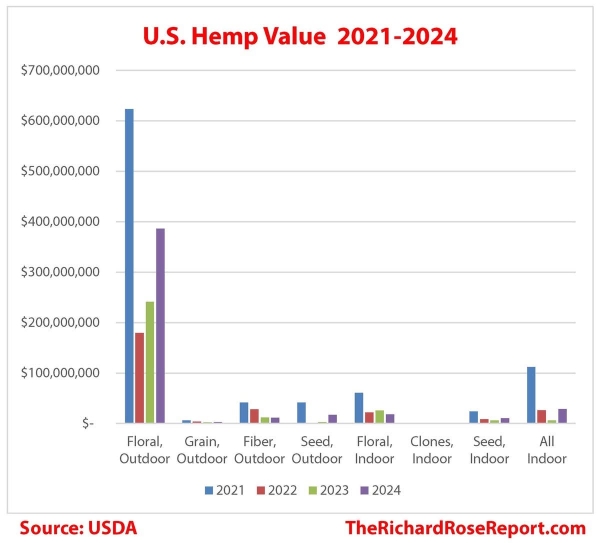
Further, The Goodness of Hemp Act throws floral hemp, the most popular product grown in the U.S. for many years, under the bus.
It usurps FDA’s expertise by banning inhalables and topicals, and over-regulates CBD as if it were THC.
Marketing Orders are notoriously corrupt and unpopular and will be difficult to administer for a plant with many primary products and few acres.
Allows 9 mg of THC per 24 oz. can (2.5 mg is the psychoactive minimum in the absence of CBD).
It forces CBD into Medicare’s CMS program, and legalizes via the back door hemp animal feed, CBD, THC, and minor cannabinoids.
The proposed excise tax is 5-10x higher than Yale Budget Lab recommends for THC. Requires FDA and TTB coordination (did you know alcohol is a food to FDA?).
Several other details deserve scrutiny. The ban on inhalables is pandering and not supported by science: baby, meet bath water. Many patients need inhalable medicine for good reasons, since inhalation is the fastest administration method, and vapes, flowers, and concentrates aren’t going away. Better to recognize that and regulate properly: metals, residual solvents, pesticides, mold, and bacteria. Dr. Tashkin spent a 50-year career trying to prove that smoking marijuana caused lung cancer and decreased lung function, and failed. Yet a hemp association knows better?
Likewise, the oral-only delivery system: which routes of administration are acceptable is for the FDA to decide once an NDI or drug application is made. We’re hempsters, not doctors; leave medicine delivery systems to them.
Ten-milligram drinks do little for patients, but they are a boon for the beer distributors who will handle them as their alcohol sales continue to drop. Raising an access or patient-care argument for Hempnoids is flawed anyway: how many unknown and possibly toxic compounds would you like with your patient’s THC? Pot is grown in every county in the country, with robust caregiver networks and an established gray market in every state.
We also don’t need THC to fund hemp research. That is a fundamental USDA process we are best not to restrict to just THC sales or to risk encouraging USDA to continue to ignore hemp because of the association with the drug.
As for marketing orders, we grow about a third as many acres of hemp as sesame seed in the U.S., and the plant’s diverse primary products make it even more complicated, so it is premature. At least start by giving farmers subsidies before demanding fees, which is the only way big commodity farms stay afloat.
In the earlier v7.5.4 summary, the revenue allocations listed were 1% for road-safety enforcement and testing, 1% for state age verification and retail compliance, and only 5% for USDA hemp farmer assistance and market development.
It’s never a good idea to force the FDA to do what it is unwilling to do; for example, it is months late on that list of stony cannabinoids Congress mandated. The Goodness of Hemp Act removes the drug-preclusion policy, a massive loss of market exclusivity for Epidiolex, and repeals section 781, the Hempnoid ban going into effect in December, 2026.
But hemp legalization requires true decriminalization, and not being under the gun of the highly political Farm Bill every five years. Marijuana decrim must happen for hemp to ever be a truly normal ag crop. Advocating for “Hemp THC” like this is going to sink the decades of work we’ve put in to legalize and normalize, and slow true Cannabis decrim such as the MORE Act and CAOA.
Why not via the Farm Bill? Once hemp is finally successful in the US, segments losing market share to her will use their sizable leverage to end it: soya, corn, flax, sunflower, cotton, meat, dairy, petroleum, construction, etc.
“You never want a serious crisis to go to waste. And what I mean by that is an opportunity to do things that you think you could not do before.” —Rahm Emanuel
The Path Forward: Decriminalization
After the ban is in effect, focus your and your customer’s rage on supporting the MORE Act (H.R. 5068) and its Senate companion, the CAOA (S. 5022), to decrim it all. It deschedules all Cannabis, and hemp will never truly be free until then. With 74 cosponsors, all Democrat, and having already passed the House twice in recent years, it has gotten further than any legalization bill before it.
And with the historic rout of the GOP in November, 2026, due to an electorate frustrated with war and inflation and the perception that the GOP are the “weed cops,” 2027 is the year. The ranks allied against federal decriminalization have never been larger, and the rest of us must unite for one final push. Why start anew with a different bill for special interests only, not all of us? Focus, people, focus.
Additional Recommendations
Separate first. Bifurcate medicinal cannabinoids completely from seed, stalks, and roots, both legally and operationally, so industrial hemp doesn’t get caught up in any of this. They require different genetics, agronomy, equipment, post-harvest handling, processing, and product applications, and therefore different laws. From oversight to fees to stigma, industrial hemp no longer requires the fear-based drug restrictions of yore.
Label the source. On every product label, the source of the THC should be disclosed: converted (man-made, or “tHc”) or phyto (natural). Mandatory Country of Origin Labeling for the hemp material would also encourage a domestic industry, as would high tariffs on material imported to make them.
Standards of identity. Define what is a “hemp” product; alternatively, “hemp” should refer only to the plant and primary products: stalks, seeds, unprocessed biomass, and roots. Once Congress separates the definition of hemp growing from the processing side, this all becomes clearer. It is where every other ag product has gone; we don’t call beer “barley.”
Right agencies. FDA, not a tax agency like TTB, should regulate intoxicating cannabinoids. USDA should be the agency issuing grants for farmers, research, enforcement, supply chain, and industry growth, not the butts and booze boys.
Fair compliance testing. Handle it like is done for Schedule 1 marijuana: private labs document compliance, and anyone may collect the sample. Make the sampling protocol fairer and include more of the plant than just the dankest buds. Treat certified cultivars as a compliance metric, since government certification should count for something, and let broadacre use of certified seed preclude THC testing. Allow fewer regulations where CBD exceeds THC by 4 times or more, and stop drug testing for THC for federal employment.
A home for the medicine. Create a standalone Office of Cannabis, like FDA’s Office of Botanical Drugs, to handle nonintoxicating cannabinoids (CBD, CBG, CBC, the Varins) and “entourage effect” medicines. It could grandfather all known naturally occurring nonintoxicating phytocannabinoids to get the ball rolling, then monitor products from there. And since we’re in a law-making mood, tear down the biggest impediments to cannabinoid medicines: the drug preclusion policy in DSHEA, which gives Epidiolex an exclusive, and FDA’s single-active-molecule policy.
Use federal buying power. One of the best things the government can do for domestic hemp is buy it. Directing 5% of federal construction projects to biomaterials would greatly improve the market for hemp fiber, and adding hempseed to institutional feeding is another market creator. Protect genetics, tissue cultures, and an allowance for breeding as well.
None of this is what we worked for even a year ago, legalizing hemp THC. The Goodness of Hemp Act is an utter betrayal of every hemp activist ever, just to enrich a few conservatives while delaying true cannabis reform.
It is a profoundly horrible, terrible, awful, very bad idea. Which means it will have a good chance of success in today’s psychotic political environment, legalizing the enshittification of hemp that started years ago.
END